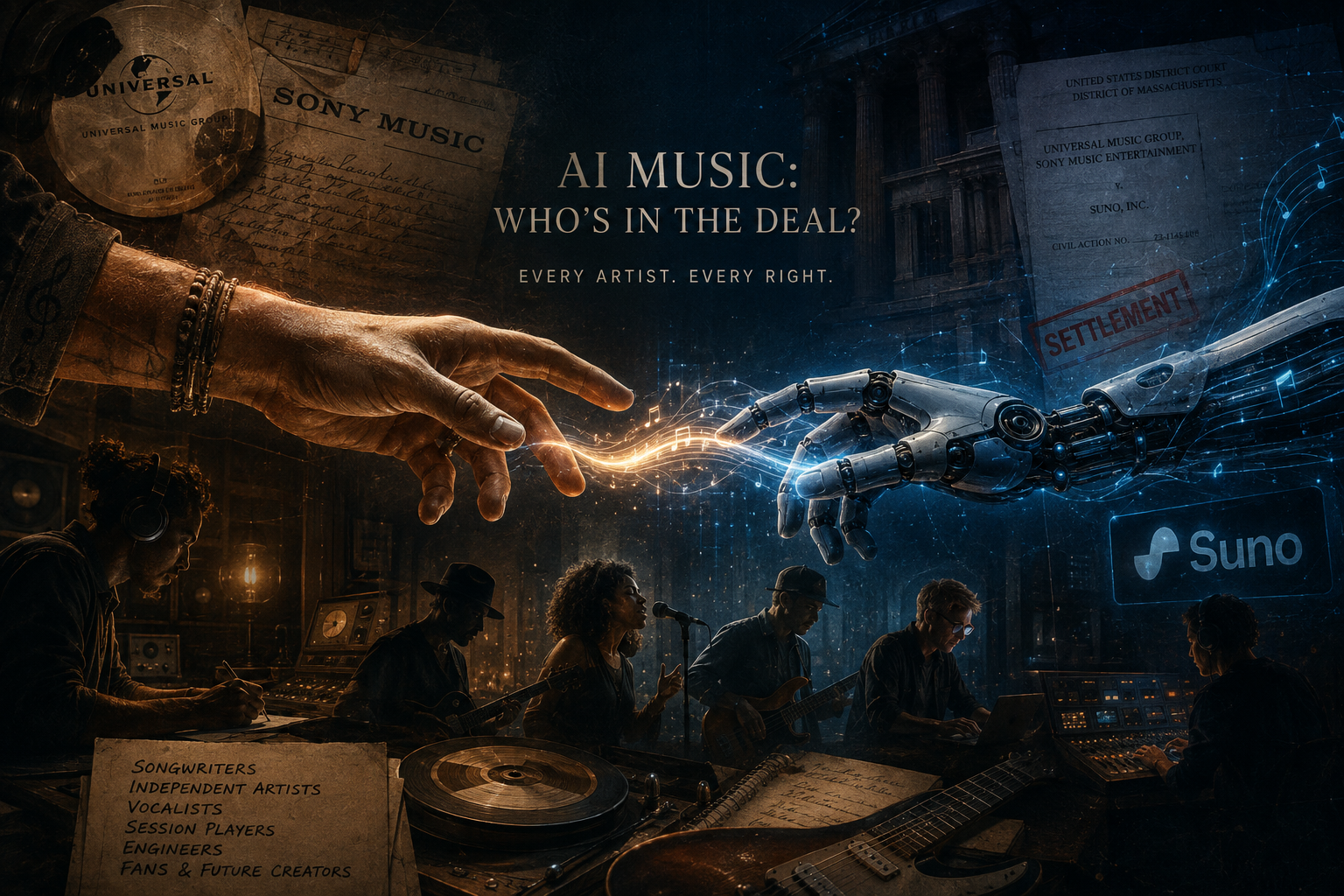
There's a courtroom in Massachusetts where the future of music13 is supposedly being decided. Universal Music Group and Sony Music Entertainment versus Suno — the last major-label lawsuit still standing against an AI music company. Every headline treats it like a cliffhanger. It isn't. I'm going to tell you how I believe it ends, why it ends that way, and what the ending should include that nobody with a seat at the table is talking about loudly enough.
The prediction
Here it is, plainly: Sony and Universal will not take this case to a verdict. They will settle with Suno, and the settlement will look a lot like the deals already on the books.
Look at the pattern. Warner Music sued Suno alongside Universal and Sony in June 202410 — then settled in late 2025, walking away with a payment and a partnership. Universal and Sony sued Udio, Suno's closest competitor9 — then settled with Udio in strategic partnerships that reportedly include ongoing licensing payments and even stakes. The Universal–Udio deal established a template: a small per-generation royalty, identification systems that flag outputs too close to catalog works, and audit rights over training data.
Every domino in this fight has fallen the same direction8. Not toward shutting AI music down — toward metering it.
The Massachusetts case has already been pushed back repeatedly; the big fair-use motions aren't even due until spring 202712. That's not a schedule that says "we're racing to a verdict." That's a schedule that says "the lawyers are negotiating while the clock runs."
What's really driving this
Strip away the press releases and the case is about two things: risk and ownership.
For Suno, the risk is existential. The company effectively conceded early on that it trained on copyrighted recordings — its entire defense rests on . If a judge rejects that defense, statutory damages across millions of recordings could be a company-ending number. No rational business bets its existence on a coin flip when a licensing deal is sitting on the table with the terms already drafted by its competitor.
For the labels, the calculation is just as cold. A courtroom win gets them damages. A settlement gets them something far more valuable: a permanent seat in the revenue stream of a technology they know is not going away. A per-generation royalty on a platform producing millions of songs is an annuity. And there's a risk on their side too — if the judge rules that AI training is fair use, the labels lose all leverage in every future negotiation. Neither side actually wants the answer. Both sides want the deal.
A German court just found Suno for 5 under German7 law143, which has no fair-use4 2. That ruling has no legal force in a US courtroom — but it raises the temperature, and rising temperature accelerates settlements.
So the "fight over AI music" was never really about whether AI music should exist. Nobody is deleting the millions of partial-AI songs already released — mine included. The fight is about who gets paid, how much, and who controls the pipes.
Where I stand: everybody in the deal, or the deal is broken
Here's the part I believe matters most, and it's where I part ways with simply cheering the settlements on.
Every artist and every rights holder whose music was used in training deserves to be part of the new deal — not just the catalogs the majors control.
The Warner deal, the Udio deals, and the Sony/Universal settlement I'm predicting all share the same blind spot: a major-label settlement only covers major-label catalog. Suno's training data, by all accounts, swept in vastly more than that11 — independent artists, small labels, self-released songwriters, session players whose work lives in recordings they never fully controlled. There's already a proposed by independent musicians making exactly this point. They're right to make it.
If the resolution of this era is "the three biggest corporations in music get equity and royalties, and everyone else gets nothing," then we haven't solved the fair use question — we've just decided that fairness is something you can only afford with a legal department.
What I support is a joint, going-forward framework modeled on the Warner deal, extended to everyone in the training data:
- Retroactive compensation for the works already used, distributed to rights holders large and small — the collecting societies (ASCAP, BMI, SoundExchange, and their international counterparts like GEMA) already have the machinery to do this. It's what they were built for. Real-life example: an independent songwriter in Nashville self-released an album in 2019, and those recordings ended up in Suno's training data. Under this framework, she gets a check — the same way she already gets an ASCAP royalty check when her song plays on the radio, and the same way musicians got paid from the big streaming settlements. The system exists; it just needs to be pointed at this.
- A per-generation royalty going forward — the meter is already invented; it just needs to pay out past the top of the food chain. Real-life example: the Universal–Udio deal reportedly pays a fraction of a cent every time the AI generates a song. Picture a water meter on the platform: a user generates 200 songs in a month, and a few dollars flow into a pool that pays out to the rights holders whose music trained the model — every one of them, not just the ones with a major-label logo. Spotify already does this math every month with streams; this is the same idea with generations.
- Content identification and disclosure — outputs that lean too close to an existing work get flagged and licensed, and platforms disclose what AI contributed. I already do this voluntarily on every release I put out, and I accept the monetization costs that come with honesty. It should be the standard, not the exception. Real-life example: YouTube's Content ID has done this for years — upload a video with a Beatles song in it, and the system catches it and routes the ad money to the rights holder instead of taking the video down. The same fingerprinting tech can listen to an AI output, notice it drifts too close to "Rasputin," and trigger a license instead of a lawsuit. And on the disclosure side: my own releases carry a "Partial AI" label on LANDR, the way a food label lists ingredients — the listener knows exactly what they're getting.
- Opt-in dignity — artists who want their work out of future training should be able to say so, and be heard. Real-life example: the "Do Not Call" registry, but for training data. An estate managing a late artist's catalog checks one box — "do not train on these recordings" — and every licensed AI platform honors it in its next model, verified by the same audits the Udio deal already requires. No lawyers, no letters, just a switch that works.
BUT — the strongest point on the other side, and I can't dismiss it
Here's the argument that keeps this from being simple, and it's the one the fair use battle is quietly leaning toward.
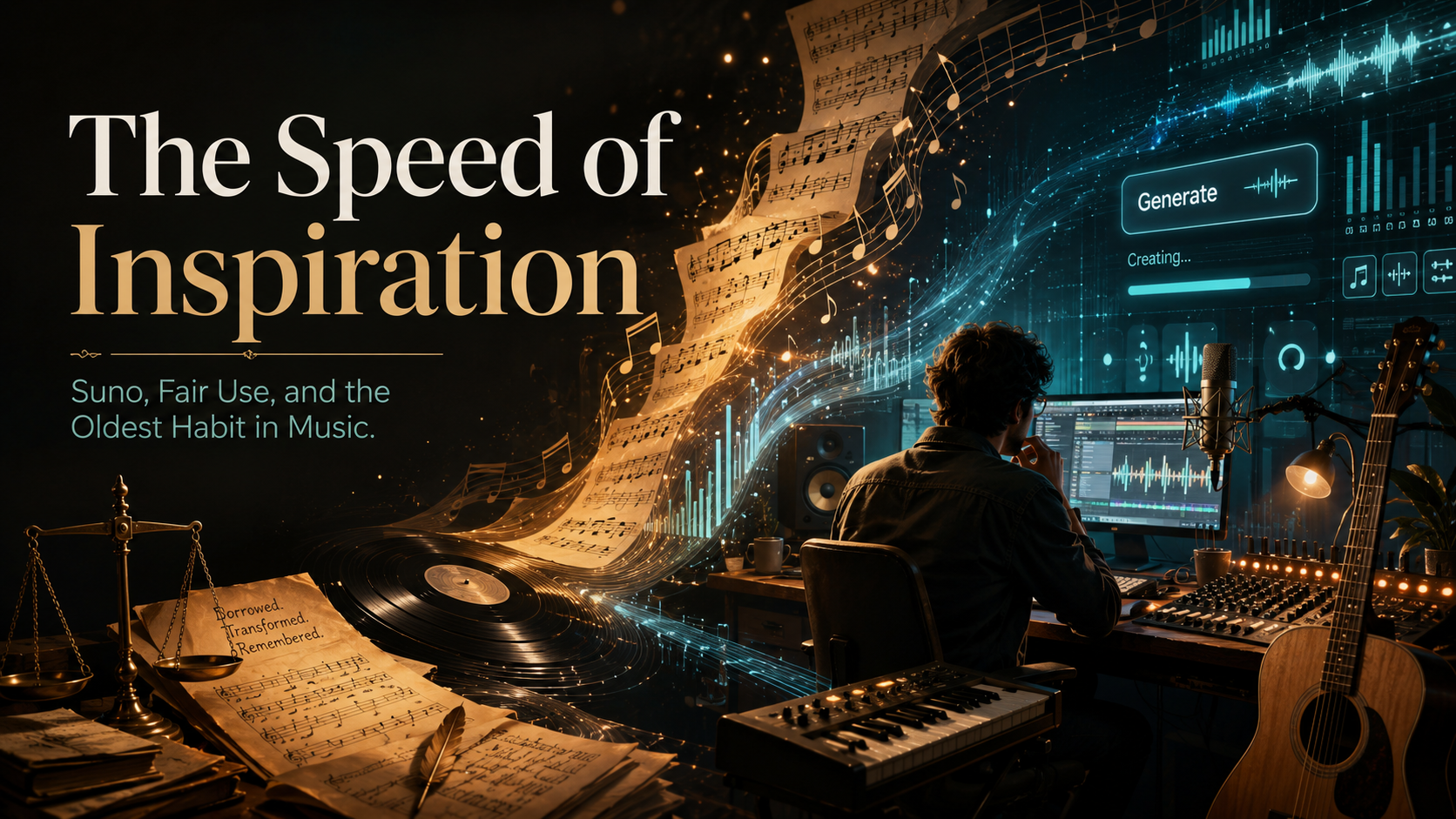
What if training an AI model on audio tracks is legally the same as what I do when I sit down with twenty paintings, absorb them, and then paint my own new painting? Nobody sends an invoice for inspiration. I don't owe a royalty to every drummer I ever studied, even though they shaped every rhythm I've played since 1986. Every musician alive is a walking training dataset of everything they've ever heard. If studying isn't infringement for me, why is it infringement for a machine?
That's not a fringe position — it's the heart of Suno's defense, and US courts have shown real sympathy for it. In the Bartz v. Anthropic decision, a federal judge found that training an AI on copyrighted books was transformative15 — comparable to a person reading and learning — and that reasoning is exactly what Suno is pointing to. The fair use factor about "purpose and character of the use" genuinely leans this way: the model doesn't store songs like a jukebox; it learns patterns the way a student learns theory. If the Massachusetts court ever rules on the merits, this argument could win on the training question. Anyone predicting this case honestly has to say that out loud.
So why do I still land where I land? Two reasons. First, scale changes the nature of a thing. I absorb twenty paintings over an afternoon; a model ingests millions of recordings in a training run and then produces finished, market-ready songs by the thousands per hour — songs that compete directly with the very recordings that taught it. That's the fair use factor pointing the other way (market harm), and it's the one that cuts hardest against Suno. Inspiration at human speed and industrial ingestion at machine speed may share a principle, but they don't share an economy. Second — and this is the practical truth — the inspiration argument's very strength is why the labels will settle. If Sony and Universal thought the "twenty paintings" defense was weak, they'd race to a verdict. The fact that it might win is exactly what pushes both sides to the table. The doctrine is uncertain; the deal is not.
So I hold both things at once, and I think honesty requires it: training probably is the machine version of the oldest thing artists do — and the people whose work fed the machine should still be in the deal, because the machine doesn't just learn from the market. It sells into it.
AI is here to stay — because it was always here
I've made this argument before, and I'll keep making it: what an AI model does with a training catalog is a hyper-accelerated version of what every musician has done since the first drummer heard the second drummer. We study. We absorb. We internalize thousands of songs and then make something that is ours but carries all of them inside it. Technology's only constant contribution to art has been speed and access — the multitrack recorder, the sampler, the , and now this.
As far back as I can remember in this life — going back to being a kid in Tustin, California — I was creative, and I loved making art. Even then, it was never about how the art got made. The test was a set of questions I posed to myself: Is it mine? Is it original? Does it portray what I'm trying to create? That was the key then, and it's the key now.
I started playing drums in 1986. I stepped away from the music industry in 2005 — but I never stopped writing, never stopped creating. Artistic expression doesn't take years off just because the business does. I came back to releasing music through technology, and today I work through a complete writer-and-producer process. At its core are my own stories and lyrics about my life and experiences, brought to life the way a studio producer and director works with audio ideas and sound expressions — constant tweaks until it's all right. And I release the result honestly labeled as what it is. It passes my three questions the same way everything I've ever made had to. AI didn't replace my creativity. It handed it back to me.
So no — AI music is not going away, and it shouldn't. It IS part of modern art and creativity now, the same way electricity became part of the guitar. The Sony and Universal case won't change that, and I predict it won't even try. It will end the way these things end: with a contract.
The only question that still matters is who's named in it. My answer is simple: everyone whose music taught the machine.