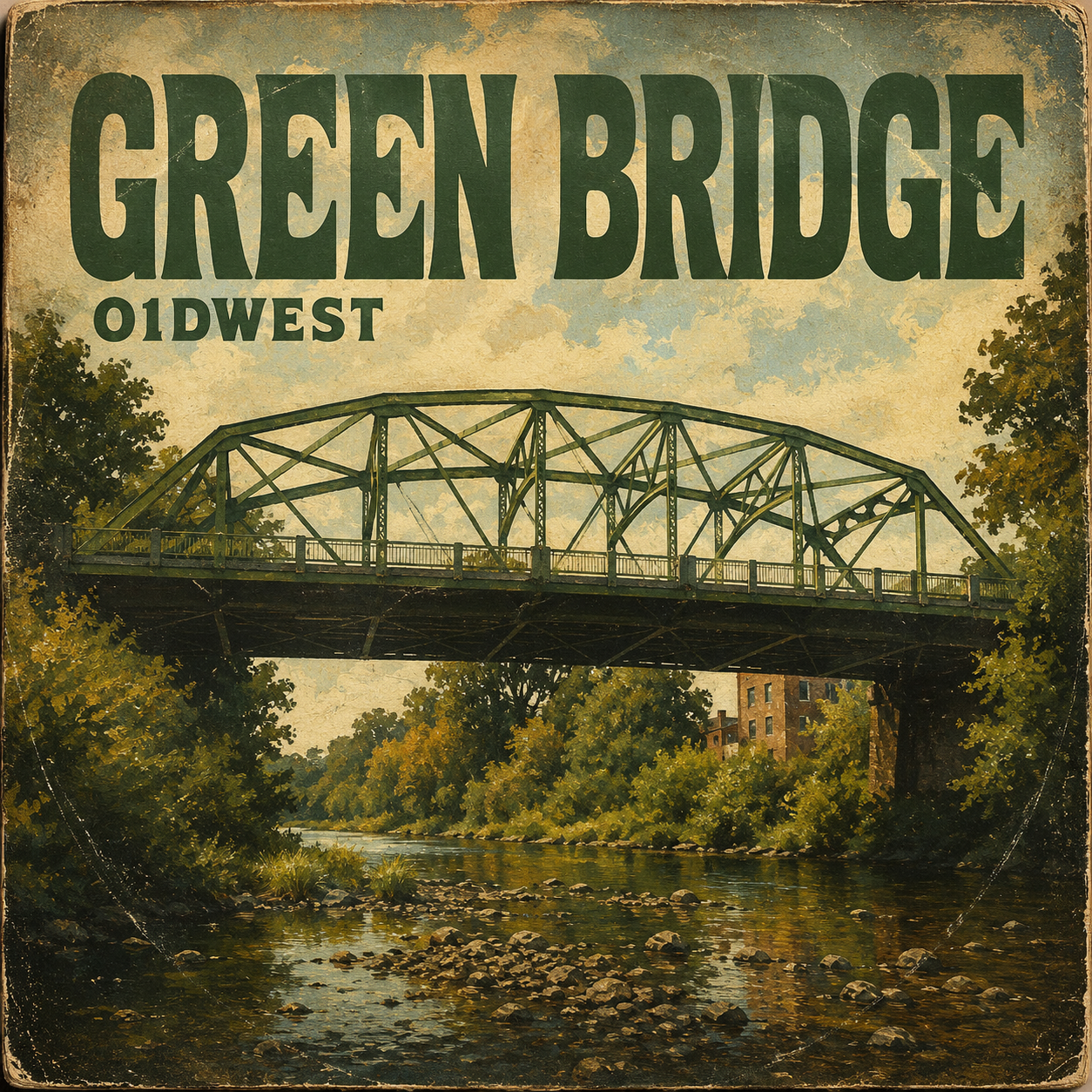
This is the companion article to "Green Bridge," the new release by 01DW3ST. The song was written for a real bridge in a real town: the steel span over the South Yamhill River in Sheridan, Oregon — the only river crossing in the city, painted green, standing since 1939. It has watched everything this article describes. The song calls it a witness. The history says the song is right.
Every timber town in the has a version of this story, but Sheridan's version deserves to be told with its own names and its own numbers — because what happened here in the late 1980s and early 1990s was not a slow fade. It was a collapse ordered on paper, from far away, that landed on people who had built a hundred years of life out of sweat, sawdust, and grain. The song puts it in one line: no hands in the dirt, no skin in the game — just numbers and profit tied to a name. This article puts the receipts behind that line: what Sheridan was, exactly what hit it, the verified statistics of the fall, what the town did to survive — and why the fire, as the song insists, was never actually put out.
Every claim is sourced at the bottom, and every , industry term, and name is defined in the glossary at the end — so no reader needs a forestry degree, a law degree, or a Yamhill County address to follow the whole story.
Why This Song Exists
"Green Bridge" was not written from a distance. 01DW3ST lived in Sheridan for eleven years, at four different addresses around town — long enough to know it from more than one porch, more than one street, more than one side of the river. And in a town that size, the history is not in a book; it is in the people. Neighbors, old-timers, coworkers, folks at the counter — the stories about what the nineties did here came up again and again, told firsthand by the people who lived through the mill years and the years after: what the town was, what got taken, and what it cost the families who stayed. Those stories took root. By 2005 the song had already started — first as an idea that would not let go, then as fragments and images gathered over the years: the mill yards, the worn-out boards, the empty stares, and always, at the center of it, the green steel bridge that has carried every era of the story across the same slow river. Two decades of listening went into these verses before they were ever written down.
The song exists because the standard telling of the 1990s timber wars is always about something else — an owl, a courtroom, a policy — and almost never about the specific human beings underneath the decision. In Sheridan, those human beings were "fathers who built a life from strain": men and women with hands like iron who cut timber cleanly and honestly, fed their families from it, and asked nothing else. When the paper lines were drawn — by judges, agencies, and appeals courts hundreds of miles away, by people who had never stood in the mill yards or smelled the cut grain — the workers were not consulted, compensated fairly, or, in the eyes of many, even seen. dimmed. Some fought the hurt with a bottle. Every porch knew the empty stare.
But the song is not a , and neither is this article. Its argument is the bridge itself: the thing that stood there steady while the whole ground gave. Sheridan bent. Sheridan did not break. What was buried here wasn't lost or gone — it was waiting, all along. Here is the whole story.
Part One: The Town the Timber Built
Sheridan began the way most Willamette Valley towns began: with one family and a river. In 1847, a settler named claimed land on the north bank of the South Yamhill River; his relatives settled the south bank. A nail, a tin can, and a post on Faulconer's land became the town's first mailbox. By 1852 there was a general store; by 1865 a much-needed first bridge connected the two banks — the great-grandfather of the green bridge in the song. The town took its name from Lieutenant , the future Civil War general, who was stationed at nearby in the late 1850s on the edge of the Reservation and was a frequent visitor at the Faulconer place. Sheridan as a city in 1880.
It grew as a working town from the very start. By 1894 it had 400 residents, a bank, two hotels, three churches, and a flour mill, with a daily train and a daily stagecoach from . The fields around it grew , clover-seed, hay, potatoes, onions, apples, prunes, and pears. And the timber was already asserting itself: in March 1910, 150 workers at the Sheridan Company's yard went on strike for higher wages — and won. Boot heels ringing on the worn-out boards, a town full of fire, a town full of will: that fire is on the record as early as 1910.
Sheridan was tested early and often. In July 1913, a fire destroyed most of the downtown; the town rebuilt. In 1932 the state pushed a highway through town — the , now Oregon Route 18 — connecting McMinnville to the coast. And in 1939, with Works Progress Administration funds — Depression-era federal money that put unemployed Americans to work building public works — the current steel bridge across the South Yamhill River was built and opened. That bridge, painted green, is still the only river crossing in the city. It is the bridge in the song.
It earned its role as witness almost immediately. By 1940 the timber industry was rising fast alongside agriculture, and the town had grown past a thousand people. On December 22, 1964, the South Yamhill delivered the worst flood in Sheridan's history, overflowing its banks and cutting the town off from the world for two days — and the bridge stood there steady while the water raged, exactly as the chorus remembers. Through the postwar boom, Sheridan and its twin timber town of Willamina, ten miles west, lived the classic Northwest arrangement: the foothills full of , the mill yards and long-cut rows down by the river, smoke from the timber and sweat in the grain. A young man could walk out of high school and into the mill and make more money than his teachers — buy a house, a truck, raise a family on the mountainside. It was hard work, and it was enough. For decades, it was more than enough.
Then the cold wind came.
Part Two: The Numbers Don't Lie — What Actually Hit the Timber Towns
The collapse that the song mourns was real, it was measured, and it came in waves. Understanding it requires honesty about all of them — because the full truth is harder, and more damning, than any single villain.
The foundation was . In 1952, the peak year of the old era, western Oregon harvested 10.4 billion board feet of timber — a being the industry's basic unit, a piece of wood one foot square and one inch thick. About a third of that came off federal land managed by the U.S. Forest Service and the . By 1963, for the first time, more timber was being cut on federal land than private land, and for the next generation the two stayed roughly even. That detail matters enormously: towns like Sheridan had come to depend on trees that belonged to the public and could be shut off by a signature. The pipeline ran through Washington, D.C. long before anyone drew an owl on a map.
The first wave was economic, and it came before the owl. In October 1979 the bottom fell out of the wood-products market. Over the next three years lumber prices fell by more than 48 percent — nearly half — as high strangled home building. Canadian lumber and Southern pine undercut Northwest mills; Japan's appetite for raw Douglas fir logs made it more profitable to ship whole logs overseas than to mill them at home, so family-wage mill jobs sailed out of ports while the logs did; and aging mills needed expensive to survive, which meant the survivors employed far fewer people per log. By the time the national economy recovered in the mid-1980s, 48,000 Pacific Northwest lumber jobs were gone — most of them never to return. In December 1984, four of the five Oregon counties with the worst unemployment were timber counties, running between 13.7 and 20.7 percent — roughly one worker in five or six standing idle. The Oregon Encyclopedia records that Sheridan's timber economy "faltered in the late 1980s" — before the famous court orders. The vise was already closing.
Then came the paper lines. In June 1990, the U.S. Fish and Wildlife Service listed the as a threatened species under the , which legally required protection of the owl's old-growth forest . In May 1991, federal District Judge William Dwyer in Seattle prohibited timber sales in potential spotted owl habitat across the national forests, ruling that the Forest Service and the Fish and Wildlife Service had failed "to comply with the laws protecting wildlife" — and the appeals ran through the , headquartered in San Francisco. This is the song's second verse, almost literally: early nineties came with a distant cry, from California lines drawing hard and wide — paper lines drawn where the timber once stood, decisions made far from sweat and from wood. Protection circles were drawn around owl nest sites; reserve boundaries were drawn across forest maps. In 1993 President convened scientists and economists in , and in 1994 the resulting permanently redrew the working forest, setting most remaining federal aside.
The scale of the shutoff is the central statistic of this article. Between the late 1980s and the year 2000, the timber from federal forests fell by more than 90 percent — while the harvest on all other lands fell only about 20 percent. Read that plainly: for every ten log trucks that had been rolling out of the national forests at the end of the eighties, nine were gone within a decade. The Forest Service's Oregon harvests, which had been running at record levels through the 1980s, all but stopped. And the jobs followed the logs: Oregon's wood-products employment fell from more than 81,000 workers in 1978 to about 29,000 by 2016 — nearly two out of every three jobs in the state's signature industry, gone. Timber, which had once represented more than half of Oregon's economy, fell to under 12 percent.
Who deserves the blame is the argument that never ended. To the towns, the owl decisions were a betrayal signed by people with no skin in the game — and the towns were not wrong that the deciders were distant, , and unsacrificing. To the scientists and courts, the old growth was nearly gone after a century of accelerating cut, the owl was an — a living gauge of an entire collapsing — and the record harvests of the 1980s were borrowing against a future that was about to default anyway. And underneath both arguments ran the forces nobody's bumper sticker mentioned: the recession had already killed 48,000 jobs before the owl was listed; automation meant even surviving mills needed fewer hands; and raw logs from private land kept sailing to Asia from Oregon docks while local mills starved for supply. The honest verdict is that the timber towns were hit by everything at once — market, machine, export ship, and court order — and that the people who absorbed the blow were the only ones in the story who had done nothing but work. The song's stands regardless of which cause you weight heaviest: the decisions were made far from the sweat, and the cost was paid close to it.
Part Three: What It Did to Towns Like Sheridan
Statewide numbers are abstract. What they meant on the ground was specific, and the song's second verse describes it with documentary accuracy.
When a mill town loses its mill economy, the damage does not stop at the mill gate. The pattern repeated across Oregon — in , in Prineville, in , in , in the Yamhill Valley — and researchers and journalists documented the same sequence everywhere: the family-wage jobs vanish first; then the trucking, the log yards, the equipment dealers, the diners that fed the crews. Local tax revenue collapses, so schools, services, and community organizations starve next. Main Street dims — literally, as storefronts go dark one by one. Young families move away chasing work; the people who stay skew older; and the town is left with what one Oregon business journal bluntly called the timber towns' choice: or die.
And then there is the damage that never shows up in an economics table. Dislocated timber workers were men whose identity was the work itself — the strength, the skill, the danger, the provision. In town after town, the years after the shutoff brought exactly what the song describes: some fought the hurt with a bottle's burn; some got lost where the lights don't turn; and every porch knew that empty stare, like the future packed up and left nowhere. The social record of Oregon's timber counties through the 1990s — unemployment running far above state and national averages, with all the private grief that follows joblessness in a proud town — is the statistical shadow of those lines. A workforce advocate in Douglas County put the lost world in one sentence: for decades, a young man could drop out of high school, walk into a mill, and start making more money than his high school teachers. That door did not swing shut slowly. It slammed.
Sheridan and Willamina lived their own version. The twin towns' timber economy faltered in the late 1980s and never returned to what it was. The mill yards and long-cut rows along the South Yamhill thinned out. What makes Sheridan's story different — and what earns the song its defiant final chorus — is what the town did about it.
Part Four: The Pivot — How Sheridan Refused to Die
Here is the remarkable, verifiable thing: Sheridan saw the collapse coming and started fighting for its future almost a decade before the worst of it landed.
The prison campaign began in 1981. With the early-eighties recession already gutting timber employment, Sheridan began campaigning to become the site of Oregon's first-ever federal prison. It was not a glamorous prize, and it divided opinion — prisons always do — but it was hundreds of stable, federally funded jobs that no lumber market and no court order could ever shut off. Oregon's Senator and Congressman threw their weight behind the bid; federal officials began scouting sites around Sheridan in 1985; construction began in 1987 on farmland south of town; and the , Sheridan — a roughly $50 million minimum- and medium-security facility — opened in May 1989 and was dedicated that August. The timing tells the whole story: the gates opened one year before the spotted owl listing and two years before the Dwyer . As the federal timber pipeline was being welded shut, Sheridan had already built its replacement. The prison became, and remains, the largest employer in the city — roughly 500 jobs at the turn of the millennium. Between 1990 and 2000 the city's official population jumped from 3,893 to 5,442.
There is one detail inside the prison that reads like the town's history winking at itself: for years, the facility's federal prison industry program operated a wood shop, manufacturing desks and office furniture. In the town the timber built, after the timber was taken, the last industrial woodworking happened behind the wire.
Then came the casino. In 1995, the Confederated Tribes of Grand Ronde — the descendants of the peoples confined to the reservation that Lieutenant Sheridan once patrolled — opened Spirit Mountain Casino just west of town. By 2000 it was the largest employer in the entire area, with roughly 1,000 workers. The historical symmetry is impossible to miss: the community that had been first became, a century and a half later, the region's economic anchor — another people who bent under everything history threw at them and did not break, now helping hold up the valley that once held them down.
And the town diversified beyond both. Manufacturing stayed — a dozen manufacturing companies operated in Sheridan into the 2000s, including a manufactured-home builder employing about a hundred people. An artist community took root. And around the town, Yamhill County's fields began converting to the crop that would make the county internationally famous: wine grapes, the engine of Oregon's booming wine industry, drawing visitors down the same Highway 18 that once carried log trucks. The ground the song swears by — there's a fire in the dirt, there's a weight in the grain — turned out to mean it literally. The dirt still produces. It never stopped.
None of this is a fairy tale. A prison is not a mill; a casino paycheck is not a green-chain paycheck; the timber wage was never fully replaced, and the ache the song carries is carried by real families to this day. But the claim of the final chorus is not that the loss didn't happen. It is that the town outlived it. Sheridan's population today is larger than it ever was in the timber years. The town that burned in 1913, flooded in 1964, and had its industry shut off by distant paper in the 1990s is still there, still working, still holding its one traffic light at Bridge and Main — and still crossing the same green bridge.
Part Five: The Bridge
Every element of the song's central image is factual. The bridge is real: the steel span carrying Bridge Street over the South Yamhill River, built in 1939 with Works Progress Administration funds — meaning it was itself born from a national catastrophe, built by workers idled by the and put back to work by public will. It is the only crossing of the river inside the city, which means every Sheridan life for more than eight decades has passed over it: mill crews and farm trucks, school buses and funeral processions, flood years and fire years, the boom and the breaking. It stood through the record flood of 1964 while the river cut the town off around it. It was standing when the last big timber decade ended, and it is standing now.
That is why the song addresses the bridge instead of a politician, a judge, or an owl. Everyone else in the story chose a side. The bridge just held — steady while the whole ground gave — connecting the two halves of a town that refused to let a river, a fire, a flood, or a federal split it permanently in two. In a story where the deciding was done far away, the bridge is the one piece of that never left, never voted, and never lied. The song gives Sheridan's endurance a body, and the body was already painted green.
What was buried here wasn't lost or gone. It was waiting — all along. By the green bridge.