By Jason Wydro — w3developing, LLC Published July 2026. This article covers active ; every claim is dated and sourced so you can check what has changed since publication. A ruling on the core question could arrive within weeks of this going live.
Disclosure, because credibility demands it: I am a lifelong musician and songwriter, a career technologist, and a paying Suno user. I release music under the name 01DW3ST, I disclose involvement on every track I distribute, and I claim authorship only of what I actually author — lyrics, vocals, and hands-on production. I have skin in this game on both sides of it: as an artist whose recordings sit on the same streaming services these models learned from, and as a working creator using the tools. That double position is exactly why I'm writing this.
I have spent my whole life in two rooms.
The first room is wherever the music happens — stages, studios, garages, back porches, parking lots after the show. I grew up in that room, writing and playing alongside genuinely incredible musicians, and I can tell you what actually goes on in there, because it is not what the lawsuits describe. What goes on in there is study. Relentless, obsessive, detailed study of other people's music.
The second room is the server room. I have made my career and my business in digital technology since 1999 — websites, e-commerce, , and now AI workflows. And from that room I can tell you the one constant that has driven every technology I have ever watched arrive: speed. How much faster can we make it, produce it, share it, learn it? Photoshop didn't invent image manipulation — darkrooms did that — it made it fast. GarageBand didn't invent the home recording — the four-track cassette did that — it made it fast. Email didn't invent the letter. It made it instant.
In June 2024, the world's three largest record companies sued Suno, the AI music generator, for training its model on their recordings1, and Suno answered with two words that set off a war: 2. This article is about that claim — what fair use actually is, what the courts have said, what the labels allege (including the stream-ripping accusations of 2025 and the hacked source code that surfaced this very month), and the strongest version of both sides. I'll argue a specific thesis, and I'll be honest about where it bends:
Training an AI model on recorded music is the thing musicians have always done — listen, absorb, deconstruct, and synthesize — accelerated by orders of magnitude. The activity is old. Only the speed is new. But how you acquire what you study has always mattered, morally and legally, and that is where Suno's claim faces its hardest test.
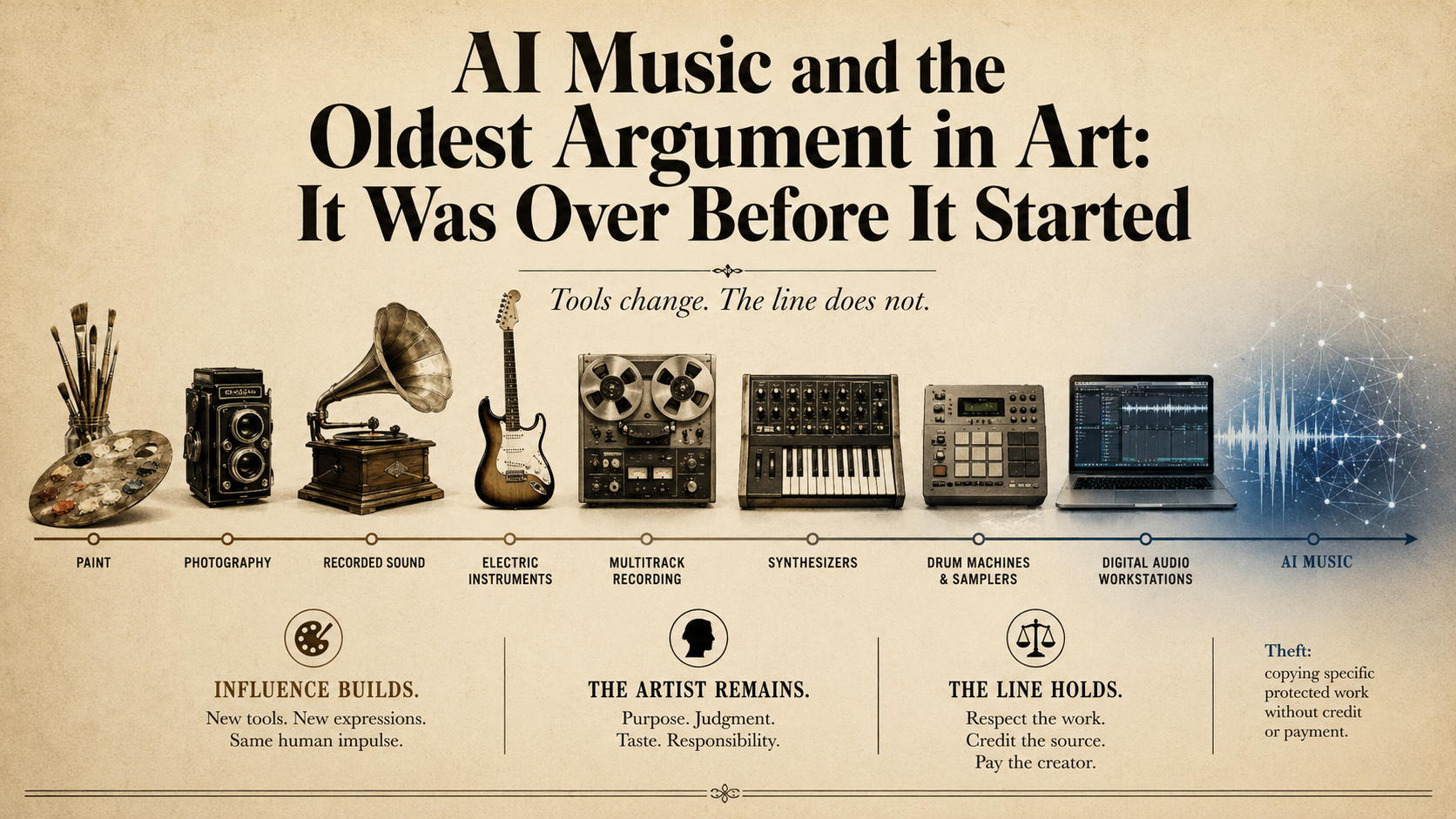
If you want the deeper history of why every new creative technology triggers the same panic — how the argument was, in a sense, over before it started — I covered that in my earlier essay, AI Music and the Oldest Argument in Art. This article is narrower and sharper: one company, one legal , one live case.
Part One: How Musicians Actually Learn (A Field Report)
Before we touch the law, let me describe the behavior at the center of this dispute, from someone who has done it his whole life.
Every single artist I have ever worked with — every one, without exception — was built out of other artists. And I do not mean "influenced" in the soft, liner-notes sense of "I like those guys." I mean research. I mean sitting with a record and playing eight seconds of it forty times to figure out whether that guitar tone was a natural or a , whether that vocal accent was an accident the producer kept or a choice the singer made, whether that drum sound was a room or a or a trick of tape compression. Was it purpose or luck? A physical device or a digital effect? These were the questions, and answering them was the education.
And here is the part the current debate keeps forgetting: the method of that education has been continuously accelerated by technology, and nobody ever called the acceleration theft.
- The magazine era. You scoured guitar magazines, read interviews, traded rumors at the record store, and begged the older player in town to show you the voicing. Learning one sound could take a season.
- The home-internet era. Suddenly the research was at your fingertips. Any song, in a second. Tabs, forums, gear breakdowns, isolated stems, interviews — any music, studied at any hour, for roughly the cost of a modem and a phone line. The days of scouring and rumor were simply gone. Every working musician and writer I know — every one — has used the speed and abundance of the internet to nurture, write, or produce a song. That is not a confession; it is a job description.
- The tool era. Sampling hardware, , , amp modelers that ship with a thousand classic tones pre-analyzed. Each step collapsed the distance between hearing something and understanding it.
The through-line is the same activity — absorb the recorded tradition, extract the patterns, make something of your own — delivered faster each decade. The best analogy I can offer is the one from my own two rooms: music learning went from paper letters in the mail to instant delivery. Nobody argued that email was an illegitimate way to correspond because letters used to take a week. The correspondence is the point; the speed is the era.
My contention is that a model like Suno's sits on this same line. It ingests the recorded tradition, extracts statistical patterns — how melodies resolve, how a shuffle sits behind the beat, how a voice and a room interact — and generates new combinations on demand. It does what musicians have always done, at maybe a hundred times the accessibility and a million times the speed. Whether the law sees it that way is the question the rest of this article takes seriously — including the strongest reasons to think I'm wrong.
Part Two: What Fair Use Actually Is (and Isn't)
Fair use is not a loophole, and it is not permission. It is a doctrine written directly into U.S. law — Section 107 of the Copyright Act — that makes certain unauthorized uses of copyrighted work non-infringing, because copyright's constitutional purpose is "to promote the Progress of Science and useful Arts," not to grant absolute control3. Courts weigh four factors, none of them decisive alone:
- Purpose and character of the use — including whether it's commercial, and crucially whether it is transformative: does it add new purpose or meaning rather than substituting for the original?
- Nature of the copyrighted work — creative works (like songs) get more protection than factual ones.
- Amount and substantiality — how much was taken, relative to what the purpose required.
- Effect on the market — does the use harm the market for, or value of, the original? Courts have repeatedly signaled this factor may matter most.
Three landmark cases frame everything in the Suno fight:
Sony v. Universal (1984) — the Betamax case. Hollywood sued the VCR itself; its chief lobbyist famously told Congress the machine was to the American film industry what "the Boston Strangler" was to a woman home alone4. The Supreme Court held that home time-shifting was fair use — and the technology the studios tried to kill went on to become, via home video, one of the most profitable markets Hollywood ever had. Remember this shape: industry sues the new machine, loses, then gets rich on the machine. It recurs.
The simplified version: Your favorite show comes on during soccer practice, so your mom records it and you watch it after dinner. The TV company said the people who make the recorder were helping everybody steal shows. The court said: wait — you were already allowed to watch that show for free; recording it just lets you watch it later. Watching at a different time isn't stealing, and you can't ban a machine that's mostly used for perfectly fine things. (Then the movie companies started selling tapes for that same machine and made more money than ever.)
Campbell v. Acuff-Rose (1994) — the Supreme Court held that 2 Live Crew's commercial parody of Roy Orbison's "Oh, Pretty Woman" could be fair use, cementing transformativeness as the engine of the first factor. Commerciality alone doesn't kill fair use; substitution does5.
The simplified version: A kid takes a famous song everybody knows and rewrites the words to make fun of it. To make fun of a song, you have to copy enough of it that people recognize what you're joking about — a joke about a song nobody recognizes isn't a joke. The court said: the funny version has a totally different job than the original (it makes you laugh at the song, it doesn't replace the song on the radio), so copying that much can be fair — even if the kid sells his funny version. What matters isn't whether you made money; it's whether your version does a new job or just takes the old song's job.
Authors Guild v. Google (2015) — the closest ancestor of the AI cases. Google copied tens of millions of entire books, without permission, to build a searchable index. The Second Circuit held it was fair use, because the copying served a transformative purpose — enabling search and analysis — and delivered snippets, not substitutes for the books6. Wholesale ingestion of complete copyrighted works, for a machine's internal purposes, judged fair. That precedent is why AI companies believed they were on solid ground.
The simplified version: Imagine a librarian who reads every single book in the library and builds a giant catalog, so when you ask "which books talk about volcanoes?" she can tell you instantly and show you a sentence or two from each. She had to copy whole books into her catalog to build it — but nobody can read a book through the catalog. It only helps you find books. The court said: copying everything to build a finding tool is a brand-new job that doesn't replace the books, so it's fair. That's the case AI companies point to and say: our model read everything to build a making tool, not to hand out copies.
And one recent counterweight: Andy Warhol Foundation v. Goldsmith (2023), where the Supreme Court narrowed transformativeness, holding that when a use serves the same commercial purpose as the original ( an image of Prince to a magazine), claiming a new "meaning or message" isn't enough. The labels cite Warhol constantly, and they are right that it changed the temperature.
The simplified version: A photographer takes a picture of a famous singer. A painter colors over that photo and makes it look totally different and cool. But then the painter's version gets sold to a magazine to be the picture of the singer on the page — which is the exact job the photographer's picture was for, and the exact sale she would have gotten. The court said: making it look different isn't enough if your version does the same job in the same store as the original. Different look, same job, same customer = not fair for that use. This is the labels' best card: if AI songs do the same job as real songs on the same playlists, "but it's new music" may not save it.
One more myth to retire: fair use is not "whatever doesn't hurt anyone" and not automatically defeated by making money. It is a case-by-case weighing — which is exactly why the Suno case matters so much. Somebody is finally going to weigh it.
Part Three: The Case File — RIAA v. Suno, Fully Dated
Here is the complete public record as of publication, because half the online commentary conflates events that happened two years apart.
June 24, 2024 — The filing. Recording companies owned by Universal Music Group, Sony Music Entertainment, and Warner Music Group, coordinated by the RIAA, sue Suno in federal court in Massachusetts (and Udio, its closest competitor, in New York), alleging mass : that the companies copied decades of protected sound recordings to train their models. They seek statutory damages of up to $150,000 per infringed work8.
August 2024 — The admission and the defense. Suno's answer effectively concedes the core fact: its training data included copyrighted recordings. It stakes everything on fair use — arguing that learning musical patterns from recordings to generate new music is transformative, the way a human musician's listening is. This concession makes the case unusually clean: there is no real dispute about whether the music was used. The only question is whether the use was lawful9.
September 19, 2025 — The stream-ripping bombshell. Days after Anthropic's landmark $1.5 billion settlement with book authors over pirated training sources, the labels file an amended with a new theory: that Suno didn't just train on their recordings, it acquired many of them by "stream-ripping" — using code to bypass YouTube's "rolling cipher," the rotating YouTube uses to prevent downloading of streamed audio10. That, they argue, violates the 's provisions — a separate offense from infringement11, worth up to $2,500 per act, and one that fair use does not excuse. Suno's response is notable for what it doesn't say: it doesn't deny the ripping. It argues the rolling cipher is a "copy control" rather than an "access control" — the audio was already streamable by anyone — and that the DMCA only forbids circumventing the latter12. As of mid-2026, the Massachusetts court has not ruled on these claims, though in the parallel Udio case, a New York court allowed similar stream-ripping claims to proceed on May 21, 202613.
The simplified version: Think of YouTube as a free museum: anybody can walk in and look at the paintings all day, but there's a "no cameras" rule, and guards make sure you don't take pictures to keep. The labels say Suno snuck a camera past the guards and took home copies of everything — and that sneaking past guards is against the rules no matter what you planned to do with the pictures. Suno's answer is basically: the museum door was wide open — a "no cameras" sign isn't a locked door, and the law only punishes breaking locks, not breaking sign rules. No judge has decided Suno's version yet, but in the twin case against Udio, the judge said the "sneaking past the guards" complaint is serious enough to go forward. And this is a separate question from fair use — being allowed to study the paintings was never the issue; it's how you got your copies home.
October–November 2025 — The industry splits. UMG settles with Udio (October 2025) in a deal reported to include licensing payments and , and announces a licensed AI music platform. Warner settles with both companies — its Suno settlement (November 24–25, 2025) reportedly includes a licensing partnership and Suno's acquisition of Warner's Songkick14. Read that carefully: two of the three companies that called this technology existential theft15 are now its licensing partners. The Betamax shape, again.
2025–2026 — The independents enter. on behalf of independent artists pile up: Justice v. Suno (filed June 2025, Massachusetts, to dismiss argued March 2026) and Nguyen v. Suno (filed November 2025, California), the latter alleging that a majority of Suno's training tracks came from independent artists — who are covered by none of the major-label settlements16.
May–June 2026 — Escalation. UMG and Sony — the two majors still fighting Suno — move to add more than 61,000 additional recordings to the complaint; Suno opposes, and separately moves to keep the size of its under seal. The same month, Suno raises a $400 million Series D at a $5.4 billion valuation — investors betting billions that Suno wins the very argument the labels are betting they'll lose.
July 2026 — This month. Two things, days apart. First, hackers leak Suno source code, and reporting on the leaked material (led by 404 Media) indicates it appears to confirm scraping from YouTube Music, Deezer17, and other platforms — including, per the reporting, the proxy tooling used to defeat download protections, the most direct evidence yet behind the stream-ripping claims18. Second, the Massachusetts court is scheduled to hear summary judgment on Suno's fair use defense — the first time a U.S. court will squarely rule on whether training a music model on copyrighted recordings is fair use. In other words: this article is being published in the eye of the storm, on purpose.
(A note on a date you may have seen garbled online, because I initially had it garbled too: the allegations of acquisition surfaced in September 2025; the hack that appears to corroborate them was reported in July 2026. Two events, ten months apart, now converging on the same courtroom.)
Part Four: The Case FOR Suno's Fair Use Claim
Here is the strongest honest version of the argument — which happens to be the argument of my life.
1. Training is analysis, not distribution. A does not store a jukebox of the songs it trained on. It stores weights — billions of numerical parameters encoding statistical patterns: how chord progressions tend to resolve, how a snare interacts with a room, how melodies in a genre move. That is closer to what leaves a musician's ten thousand hours of listening than to what sits on a pirate server. The purpose of the copying is to learn from the works, not to deliver the works — the precise distinction that carried Google Books, where entire libraries were copied so a machine could understand them.
2. The precedents already crossed this bridge. In Bartz v. Anthropic (June 23, 2025), the first major U.S. ruling on AI training and fair use, Judge William Alsup held that training a language model on books was "exceedingly transformative" and fair use — while separately holding that acquiring books from pirate libraries was not protected19. Days later, Kadrey v. Meta also came out for the AI company on the training question. Courts remain divided on how to weigh market harm, and none of these rulings is binding on the Massachusetts court20 — but the direction of the early case law is unmistakable: learning from lawfully obtained works looks like fair use; the fights are increasingly about acquisition and outputs, not learning itself.
The simplified version (Bartz): A student reads thousands of books and gets amazingly good at writing. The judge looked at two totally different questions and gave two totally different answers. Question one: is it OK to learn from all those books? Yes — that's what books are for; learning from them is about as fair as fair use gets. Question two: is it OK that a bunch of those books came from a "free books" website that was really a pile of stolen books? No — and writing a great book report afterward doesn't un-shoplift the book. The company ended up agreeing to pay about $1.5 billion for the shoplifting part, while the learning part stayed legal. Keep those two questions separate and you understand the entire Suno case.
The simplified version (Kadrey): Same idea, different ending: the authors who sued had to show the judge how the learning actually cost them money — and they showed up without the receipts. It's like telling the teacher another kid ruined your lemonade stand but not being able to point to one single lost sale. The teacher ruled for the other kid — while warning that the next kid who brings receipts might win. That warning is why the "market harm" factor is the one everyone is watching in the Suno hearing.
3. The human parallel is not a gimmick — it is the actual history of music. Every musician is a trained model. The blues learned from field hollers; rock learned from the blues; hip-hop learned from everything with a break in it. When I studied how a band got a specific tone — reading, asking, replaying, reverse-engineering — no license was required and none was conceivable. The internet then accelerated that study a hundredfold, and we celebrated it as democratization. Suno accelerates it again. If the activity was always legitimate, the burden is on the objectors to explain why velocity changes its nature — why the letter was fine but the email is theft.
4. The market evidence is behaving like Betamax, not like . The claimed harm is market destruction; the observed behavior is market formation. Within eighteen months of calling the technology existential, Warner licensed it and sold Suno a subsidiary; UMG licensed Udio and announced its own AI platform. Industries do not license their own destruction. They license distribution channels — which is what the labels' own conduct suggests they believe this actually is. We have seen this movie: the VCR, home taping, MP3s, streaming. Each was sued as a killer; each ended up signing the checks.
5. Fair use exists precisely for this moment. The doctrine's constitutional job is to keep copyright from strangling the progress it exists to promote. A rule that pattern-learning from the recorded tradition requires a license from every rightsholder would not merely constrain Suno — it would retroactively criminalize the method by which music has always propagated, the moment a machine does it instead of a nervous system.
Part Five: The Case AGAINST — Steelmanned
If I only gave you my side, this would be marketing. Here is the opposition at full strength, because parts of it are right.
1. Scale is not just speed — at some point it becomes a different kind of thing. A human absorbing ten thousand songs over twenty years and a system ingesting tens of millions of recordings in weeks differ the way a fisherman differs from a factory trawler. The law routinely treats industrial scale as legally distinct from personal activity, and the labels argue the "learning" analogy launders an industrial act in the language of a personal one. This is the single best argument against my thesis, and it deserves a straight answer (Part Six).
2. The outputs can substitute — and factor four may be king. The labels allege Suno's models can be prompted into music substantially similar to protected recordings — evidence, they say, that expression, not just "patterns," lives in the weights. And even where outputs are wholly new, they compete: streaming playlists, sync placements, and background-music markets have finite demand, and an unlimited faucet of instant songs dilutes the value of every existing catalog — including mine. Warhol sharpened this blade: same commercial purpose, no fair use. If AI tracks do the same job as human tracks in the same markets, the fourth factor cuts hard against Suno.
3. Human learning happened inside an economy that paid artists; scraping happens outside it. When I studied records, somebody had bought the records. Radio paid performance royalties. Even the internet era's studying rode on licensed streams and purchased downloads, however imperfectly artists were paid. The training corpus, by contrast, was allegedly assembled by circumventing the very technical measures that made streaming a licensed market. "We did what musicians always did" is weakest exactly here: musicians listened through the turnstile; the allegation is that Suno jumped it.
4. The acquisition evidence is getting worse, not better. The September 2025 amended complaint alleged stream-ripping; the July 2026 source-code leak, if authenticated, appears to corroborate it in Suno's own tooling. Bartz — the very case Suno leans on — drew a bright line between transformative training (protected) and piratical acquisition (a $1.5 billion mistake). If the Massachusetts court follows that template, Suno could win the grand philosophical question and still face crushing liability for how it filled its library.
5. The settlements prove leverage, not legitimacy — and the independents got nothing. Read the other way, Warner and UMG settling shows only that litigation risk forced deals, and those deals cover major-label catalogs. The class actions allege that a majority of the training data came from independent artists — distributed through the same aggregators I use — who sit outside every settlement, uncompensated and unasked. Any honest fair-use triumphalism has to look those artists in the eye. I am one of them, on paper: my recordings live on those same streaming platforms the models learned from.
Part Six: Where I Land — The Verb and the Turnstile
So where does a person who has lived in both rooms come down?
On the verb — the training itself — I stand by the thesis without apology. Learning from the recorded tradition is not an infringement of it; it is the tradition. Every sound I have ever loved was built by someone studying someone else's record with an intensity that would look, if you wrote it down as a data-processing description, exactly like what these models do: ingest, decompose, extract pattern, recombine. The internet made that study instant and we called it progress. Suno made it instant-times-a-hundred, and the activity did not change — only the throughput did. The early court decisions on training, the Google Books precedent before them, and forty years of Betamax-shaped history all point the same direction. And to the scale objection — the strongest one — my answer is that copyright law already has a tool for weighing scale, and it is called the fourth factor. If the outputs substitute for the inputs in real markets, factor four punishes that, as it should. What the law should not do is invent a rule that the same act of learning is legal at human speed and illegal at machine speed. We do not have one law for the letter and another for the email.
On the turnstile — the acquisition — I will not carry Suno's water. How you obtain what you study has always mattered. It mattered when Bartz protected the training and billed the piracy; it matters morally in every garage I ever played in, where we bought the records we wore out. If the stream-ripping allegations hold up — and this month's leaked source code suggests the question is now evidentiary, not rhetorical — then Suno earned that exposure, and no theory of inspiration excuses it. Fair use is a defense of use, not a license to jump fences. The strongest version of the pro-AI position, the one I hold, actually requires this concession: the learning is legitimate precisely because listening always was — and listening happened through licensed channels.
On the endgame, I think it is already visible. Warner is Suno's partner. UMG is Udio's. Licensed models are announced for 2026. The destination was never prohibition; it was the same destination as radio, home taping, sampling, and streaming — a rate card. The real unfinished business is who is at that table: the settlements cover the majors' catalogs, while the independent artists whose work allegedly made up the bulk of the training data — artists like me, distributing through the same aggregators, disclosed AI and all — currently have no seat and no check. If the courts and the industry get one thing right in the next year, let it be a licensing framework that reaches the catalogs, not just the big three. That is the version of this future where the technology keeps its promise: the oldest habit in music — learning from everyone — finally paying everyone it learns from.
The panic, meanwhile, will pass the way it always passes. The , the , the VCR, the sampler, the DAW, Auto-Tune, the internet itself — every one arrived as a murderer of music and stayed as an instrument. I made that longer argument elsewhere; here it is enough to say that I have watched speed transform every field I have ever worked in, and not once has speed changed what the work is. Musicians study music and make more music. They did it from magazines, then from modems, and now some of them — this one included — do it with a model humming in the next window. The letter became the email. The mail still gets delivered.