Every time a new tool arrives in art, the same argument breaks out. The tool is accused of being a cheat, a fraud, a machine that will kill “real” artistry. The people using the old tools declare the new work illegitimate. A generation passes. The new tool becomes so ordinary that nobody remembers it was ever controversial, and the art made with it hangs in museums, sits in the , and plays on the radio.
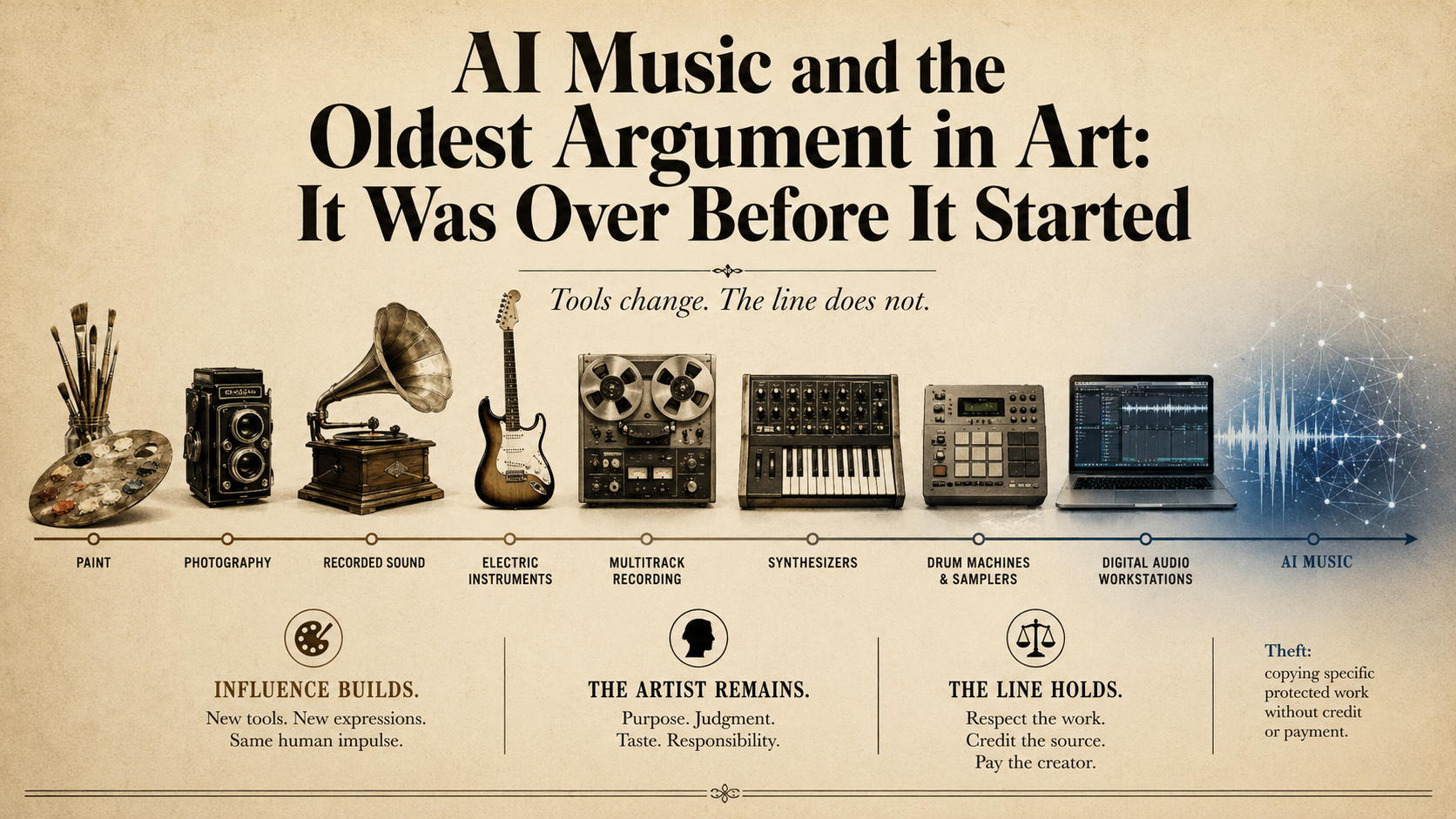
This has happened with the paint tube, the camera, the , the electric guitar, the multitrack tape machine, the synthesizer, the , the sampler, , and the laptop. It is happening now with . The argument feels new every time, but it is the same argument, and history has already ruled on it — not once, but a dozen times, always the same way.
That does not mean anything goes. There has always been a line, and the line has never moved: influence is the lifeblood of art; copying a specific, identifiable work — its exact lyrics, its exact melody, its exact recording — without credit or compensation is theft. The history of music is full of both, and the difference between them is not a matter of taste. It is a matter of documented fact, court records, and, too often, artists who died broke while their work made other people rich.
This article walks through that history: how the tools of art-making have always evolved, how borrowing has always been the engine of creativity, exactly where borrowing becomes stealing, and why the current panic over digital and AI-assisted music is the latest verse of a very old song.
Part One: The Tools Were Never Sacred
The paintbrush was technology. So was the tube it dipped into.
We think of a paintbrush as timeless, but the brush itself has a technological history. For centuries, European painters worked almost exclusively with round brushes of hog bristle or sable, hand-bound with string or quill. The invention of the seamless metal in the nineteenth century — the small metal band that clamps the bristles to the handle — made the flat brush practical for the first time. The flat brush produced the broad, visible, squared-off strokes that define Impressionist and Post-Impressionist painting. Van Gogh’s slabs of color and Monet’s broken dabs are not just a style choice; they are the fingerprint of a manufacturing innovation.
The bigger revolution was the paint itself. Before 1841, oil paint was stored in pigs’ bladders that painters punctured with a tack and could not reliably reseal. Paint dried out fast, was messy to transport, and effectively chained painters to their studios, where assistants ground pigment by hand. In 1841, an American portrait painter named patented the collapsible tin paint tube.4 Suddenly paint was portable, resealable, and available in vivid new machine-made pigments.
The result was . Monet, Renoir, and Pissarro could carry a full palette outdoors and paint light as it changed, on location, in a single sitting — the entire movement was downstream of a metal tube. said as much: his son Jean Renoir recorded him remarking that without paint in tubes, there would have been no Cézanne, no Monet, no Pissarro — nothing of what critics came to call Impressionism.3
Nobody today argues that Monet cheated because he didn’t grind his own pigment. But the argument was made at the time. Critics attacked the Impressionists as sloppy and unserious precisely because their new tools let them work fast and loose. The 1874 exhibition that gave the movement its name was widely mocked; critic coined “Impressionism” as an insult, sneering at Monet’s Impression, Sunrise as unfinished. The insult became the name of one of the most beloved movements in art history.
Photography: “From today, painting is dead”
When the — the first practical photographic process — was announced in 1839, the French painter is famously reported to have declared, “From today, painting is dead.” (The quote may be , but it perfectly captured the mood.) Twenty years later, the poet and critic used his review of the Salon of 1859 to condemn photography as the refuge of failed painters and an industrial menace that would corrupt art if it were ever allowed to encroach on it.2
Painting did not die. It did the opposite: freed from the job of literal representation, it exploded into Impressionism, , , and . And photography — the machine that supposedly required no skill, because “the machine does the work” — became an art form with its own masters, museums, and market. Ansel Adams and Henri Cartier-Bresson are not remembered as button-pushers.
There is even strong evidence that painters were using optical machinery long before 1839. The artist and physicist have argued that Old Masters — possibly including Vermeer — used the and curved mirrors to project scenes onto their canvases as drawing aids.5 The thesis is debated among art historians, but the underlying point is not: optical tools existed for centuries, artists quietly used whatever helped, and the resulting paintings are still masterpieces. The tool never disqualified the art.
Recorded sound: the century of panic
Music has run the same script more times than any other art form.
1906 — the phonograph and . , the most famous bandleader in America, published an essay in Appleton’s Magazine titled “The Menace of Mechanical Music.”1 He warned that “” would destroy amateur music-making, wither the national vocal cord, and reduce music to a soulless industrial product. He was one of the greatest musicians of his era, and he was wrong. Recording did not kill music; it created the modern music industry, preserved performances that would otherwise be lost forever, and gave Sousa’s own marches an audience of billions.
1942 — the recording ban. The American Federation of Musicians, led by , ordered its members to stop making commercial recordings entirely, fearing that records, jukeboxes, and radio would replace live musicians. The strike lasted more than two years. The union eventually won royalty payments — a real and legitimate economic fix — but the technology stayed, exactly as it always does. Note the pattern: the winning move was compensation, not prohibition.
The 1950s — . The guitarist pioneered “” overdubbing and commissioned the first eight-track recorder from Ampex. Suddenly a “performance” on a record could be something no band ever played in a room at the same time. Purists called it fakery. That “fakery” is how essentially every record you have ever loved was made, from Sgt. Pepper’s to Thriller. The producer’s console became an instrument in its own right.
1965 — the electric guitar. When Bob Dylan plugged in at the Newport Folk Festival on July 25, 1965, sections of the folk audience booed him as a sellout and a traitor to authentic music. The electric guitar — now the very symbol of musical authenticity — was itself once the machine that was ruining everything.
1982 — the synthesizer. Britain’s had already passed a in 1982 seeking to restrict synthesizers and drum machines in recording and broadcast work, on the grounds that they put “real” musicians out of work. Wendy Carlos’s Switched-On Bach (1968) had already proven the synthesizer could make serious, chart-topping, Grammy-winning music; the union tried to hold back the tide anyway. Today the synthesizer is simply an instrument, taught in conservatories.
The 1980s — drum machines. The Roland TR-808 was a commercial flop when it launched in 1980, dismissed for sounding nothing like real drums. That “wrong” sound became the foundation of hip-hop, electro, Miami bass, and modern pop. “Drum machines have no soul” was a bumper sticker; Marvin Gaye’s “Sexual Healing,” built on an 808, is the rebuttal.
1997 — Auto-Tune. Invented by , an engineer who had used similar signal-processing math to hunt for oil deposits, Auto-Tune was blasted as the death of real singing after Cher’s “Believe” (1998) made its robotic setting famous. Jay-Z recorded “D.O.A. (Death of Auto-Tune)” in protest. Auto-Tune outlived the protest and became both an invisible standard tool and, in the hands of T-Pain and Travis Scott, a deliberate expressive instrument.
The 2000s — the . The put a full recording studio — mixing, editing, — inside a laptop. Billie Eilish and her brother Finneas recorded When We All Fall Asleep, Where Do We Go? largely in a bedroom; it won Album of the Year at the 2020 Grammys. The gatekeeping argument (“you’re not a real artist unless you can afford Abbey Road”) did not survive contact with the results.
Every one of these tools was accused of destroying music. Every one of them instead expanded who could make music and what music could be. The pattern is not ambiguous. It is one of the most consistently repeated patterns in cultural history.
Part Two: Borrowing Is the Operating System of Music
Here is the uncomfortable truth that every honest musician knows: there is no such thing as an uninfluenced artist. Not one, in the entire history of the species.
Music is a shared language, and its grammar is communal property:
The twelve-bar blues — a specific, repeating chord structure — underlies thousands of songs by thousands of artists, from Robert Johnson to to the Rolling Stones to ZZ Top. Nobody owns it. Nobody could own it, and if anyone did, popular music would not exist.
The I–V–vi– appears in an absurd number of hit songs across every decade — the comedy group Axis of Awesome famously demonstrated dozens of them (“Let It Be,” “No Woman, No Cry,” “With or Without You,” “Someone Like You,” and on and on) in a single . Pachelbel’s Canon in D, from the seventeenth century, donated its chord sequence to a sizeable chunk of the pop charts. Chord progressions, as such, are not copyrightable — U.S. law protects original expression, not common building blocks — and the courts have repeatedly affirmed that basic musical vocabulary belongs to everyone.
The — the chunky -derived rhythm put on record in 1955 — was picked up almost immediately by Buddy Holly (“Not Fade Away”), then by the Rolling Stones, the Who, Bruce Springsteen, George Michael (“Faith”), and U2 (“Desire”). No lawsuit was possible or appropriate: a rhythm pattern is an idea, and ideas are free. Diddley himself grumbled about it for decades, understandably — but the law was never going to give one man a monopoly on a beat, any more than it would give one painter a monopoly on brushstrokes.
Folk, blues, and jazz are borrowing formalized. The folk tradition is nothing but songs passed hand to hand and rewritten — Dylan built “Blowin’ in the Wind” on the melody of the spiritual “No More Auction Block.” Jazz musicians built entire careers writing new melodies over the chord changes of “I Got Rhythm” (so common the practice has a name: “rhythm changes”). This was never scandal. It was the art form working as designed.
Hip-hop made borrowing audible. Sampling — lifting a piece of an existing recording and building something new from it — is collage as music. The most sampled recording in history is a six-second drum solo: the “,” played by drummer on The Winstons’ 1969 “Amen, Brother.” That six seconds became the rhythmic DNA of , drum and bass, and countless hip-hop tracks — used in thousands of songs. And here the story turns dark, in a way that matters for this argument: The Winstons never received royalties for any of it. Coleman died homeless in Atlanta in 2006. A campaign in 2015 raised about £24,000 for bandleader Richard Lewis Spencer — a voluntary gesture of conscience, decades late, from fans rather than from the industry that profited.13
Hold onto that story. It is the hinge of the whole argument, because it shows both truths at once: borrowing built entire genres of magnificent new music, and the specific human beings whose recorded work was taken deserved to be paid and credited, and were not. Both things are true. The mature position holds both.
Part Three: Where the Line Actually Is
Influence is legal, universal, and good. Copying a specific, identifiable, original expression is not. The courts have spent a century drawing this line, and the case law is remarkably coherent once you see the principle:
“My Sweet Lord” (1976). In Bright Tunes Music v. Harrisongs Music, a federal court found that George Harrison’s “My Sweet Lord” copied the melody of The Chiffons’ 1963 hit “He’s So Fine.” The court explicitly accepted that Harrison had not copied deliberately — it coined the standard for plagiarism — and found him anyway, ultimately for hundreds of thousands of dollars.8 The lesson: what matters is not intent but whether a specific protected melody was reproduced.
“Ice Ice Baby” (1990). Vanilla Ice lifted the instantly recognizable bassline of Queen and ’s “Under Pressure” without . The matter settled out of court; Bowie and the members of Queen received songwriting credit and payment. Nobody disputes the outcome, because the taking was of a specific, unique, identifiable musical phrase.
Grand Upright Music v. Warner Bros. Records (1991). sampled ’s “Alone Again (Naturally)” without a license. Judge Kevin Thomas Duffy opened his opinion with the words “Thou shalt not steal” and referred the matter for possible criminal prosecution. The decision ended hip-hop’s era of freewheeling uncleared sampling overnight and established that sampling a recording requires a license.9
Bridgeport Music v. Dimension Films (2005). The Sixth Circuit went further, ruling that even a tiny sample of a sound recording requires clearance, summarizing its holding in six words: “Get a license or do not sample.”10 (Other circuits have since disagreed about very small samples, but the core rule stands: recordings are owned; taking the actual recording requires permission.)
“Blurred Lines” (2015). The estate of Marvin Gaye won a verdict of roughly $5.3 million (after reduction) against Robin Thicke and Pharrell Williams over “Got to Give It Up.”11 This case is the exception that proves the rule — and a warning. Thicke and Williams did not copy Gaye’s melody or lyrics; the jury effectively found they had copied a feel, a . Hundreds of musicologists and musicians filed protests arguing the verdict punished exactly the kind of stylistic influence that has always been legal and necessary. Most legal commentary treats Blurred Lines as an overreach — evidence of what happens when the line drifts from specific expression toward vibe.
“Stairway to Heaven” (2020). The Ninth Circuit, sitting in Skidmore v. , restored sanity: Led Zeppelin did not infringe the band Spirit’s instrumental “Taurus,” because the shared element — a descending bassline over an A-minor chord — is a used for centuries, all the way back to composers.12 Common building blocks are free; only original, particular expression is protected.
Put the cases in a row and the principle is crisp:
Protected (copying is wrong): exact lyrics; a specific original melody; the actual sound recording (samples); a unique, identifiable signature phrase like the “Under Pressure” bassline.
Free for everyone (influence is legal): chord progressions; rhythms and grooves; genres and styles; instrumentation choices; production techniques; the general “feel” of an artist; scales, structures, and all the shared grammar of music.
This is where the line has always been. It is where it should stay.
Part Four: The Uncredited — What Actual Theft Looks Like
If you want to know what genuinely wrongful taking looks like — as opposed to influence — you do not need hypotheticals. American music history supplies the receipts, and they overwhelmingly point in one direction: Black artists whose work built rock and roll while the money flowed elsewhere.
Arthur “Big Boy” Crudup and Elvis Presley
’s first single, released by Sun Records in July 1954, was “That’s All Right” — a song written and recorded in 1946 by the Mississippi blues singer .6 Elvis also recorded Crudup’s “My Baby Left Me” and “So Glad You’re Mine.” Elvis, to his credit, repeatedly and publicly named Crudup as a formative influence, reportedly saying in his Sun days that if he could feel what Crudup felt, he’d be a music man like nobody ever saw.
Crudup, meanwhile, saw almost nothing. Royalties owed to him were siphoned off through the era’s standard predatory publishing arrangements; he quit the music business in disgust in the 1950s and worked as a laborer and in Virginia. In 1970, after years of legal effort, a settlement of roughly $60,000 in back royalties was negotiated — and collapsed at the signing table when the publisher refused to execute it, reportedly concluding a court fight would cost Crudup’s side more than the settlement was worth. Crudup died in 1974. His family pursued the estate’s claims for years afterward. The man who wrote the song that launched Elvis Presley spent his last working years picking crops.
Note what the wrong was — and wasn’t. Elvis performing a blues song was not the crime; cover versions, properly licensed, are how songs have always traveled, and Crudup was credited as the writer on the record label. The crime was an industry structure that took a Black songwriter’s legally owed royalties and made sure he never collected them. The theft was economic and specific, not stylistic.
Big Mama Thornton and “Hound Dog”
“Hound Dog” was written in 1952 by and Mike Stoller — two teenage songwriters — specifically for Willie Mae “Big Mama” Thornton, whose thunderous recording spent seven weeks at #1 on the R&B chart in 1953.7 Thornton later said she received a single check of about $500 for it. Elvis’s 1956 version — actually modeled on a lounge act’s rewrite he saw in Las Vegas — sold on the order of ten million copies and became one of the most famous records ever made.
Thornton, whose growls, phrasing, and attitude shaped the song’s entire identity, got no writing credit (she hadn’t written it), no royalties from Elvis’s version, and no durable share of the fortune her performance style helped create. She also wrote “Ball ’n’ Chain,” which turned into a rock landmark; Thornton did at least hold the writer’s credit there and received royalties from it in her later years. She died in 1984, in a Los Angeles boarding house, having been living in poverty.
Again, precision matters. Elvis covering a Leiber–Stoller composition was legal and ordinary. The injustice was systemic: a two-tier economy in which Black originators were paid in flat fees and obscurity while white performers of the same material were paid in millions and immortality. That is the wrong to remember — and it was committed by contracts and gatekeepers, not by the existence of cover versions.
Led Zeppelin’s ledger
Led Zeppelin is the canonical case study in the difference between influence and taking, because they did both — constantly — and the record shows exactly which was which:
“Whole Lotta Love” (1969) lifted its lyrics substantially from Willie Dixon’s “You Need Love” (recorded by Muddy Waters in 1962). Dixon sued in 1985; the case settled, and Dixon received payment and a writing credit on subsequent releases. “The Lemon Song” drew heavily on ’s “Killing Floor”; a suit by the publisher settled, and Chester Burnett (Howlin’ Wolf) was added to the credits. “Dazed and Confused” was built from a song of the same name by the American folk singer , who had opened for the Yardbirds in 1967; Holmes sued in 2010, the case settled, and later pressings credit the song as inspired by him. “Babe I’m Gonna Leave You” was written by ; she eventually received credit and substantial back royalties in the 1990s, decades after the fact.
And yet “Stairway to Heaven” — their most famous song — was cleared by a federal , because what it shared with Spirit’s “Taurus” was a centuries-old commonplace. Same band. Both verdicts correct. The line held: specific lyrics and melodies taken from named authors had to be paid for; a common chord figure did not.
Chuck Berry and “Surfin’ U.S.A.”
The Beach Boys’ 1963 hit “Surfin’ U.S.A.” set new Brian Wilson lyrics to the note-for-note melody of Chuck Berry’s “Sweet Little Sixteen” (1958). Berry’s publisher demanded and received the copyright, and Berry was eventually listed as a writer. Wilson later acknowledged the melody was Berry’s. This is the system working, if belatedly: an exact melody is owned, and using it means credit and payment.
The through-line of all of these stories: the sin was never influence. Every artist named here was drenched in influence — Crudup in Delta blues, Leiber and Stoller in R&B, Zeppelin in the entire catalog, Brian Wilson in Chuck Berry. The sin was taking specific work — a lyric, a melody, a legally owed royalty stream — from specific human beings without credit or payment, in an industry structured to let it happen to the least powerful. Fix that, and influence takes care of itself, as it has for all of human history.
Part Five: The Digital Music Era — Same Script, New Cast
Which brings us to now.
AI music generation has triggered the same three-act play the phonograph, the synthesizer, and the sampler triggered before it. Act One: the panic (“this will destroy real music”). Act Two: the lawsuits and the union motions. Act Three: , normalization, and absorption into the toolkit.
We are, verifiably, in Act Three already. In June 2024, the RIAA and the three major labels — Universal, Sony, and Warner — sued the AI music platforms Suno and Udio for training on copyrighted recordings without permission.14 By late 2025, the wall had cracked: Universal settled with Udio in October 2025, announcing a licensed AI music platform; Warner settled with both Udio and Suno in November 2025, converting its lawsuit into a licensing partnership in which artists and songwriters can opt in to having their voices and compositions used. Sony remains in , with a pivotal fair-use ruling expected in 202616, and independent artists have filed class actions arguing — with real force — that the major-label settlements leave them out entirely.15
Read that trajectory against the history above and it is almost eerily familiar. It is the 1942 musicians’ strike again: the fight was never actually about whether the technology would exist. It was about who gets paid — and the durable answer, then as now, was royalties and licensing, not prohibition. The didn’t destroy the phonograph; it won a payment system. The labels aren’t destroying AI music; they are pricing it.
And the legal line being drawn is — or should be — the same line the courts drew for Harrison, Biz Markie, and Led Zeppelin:
If an AI-assisted track reproduces the exact lyrics of an existing song, that is , exactly as it would be if a human typed them. If it reproduces a specific, identifiable original melody — the “He’s So Fine” test — that is infringement, no matter what tool produced it. If it clones a particular artist’s actual recorded voice to impersonate them, that raises genuine and legitimate new legal questions (right of publicity, among others) that deserve the serious treatment they’re now getting in courts and legislatures.
But if a human artist uses AI tools somewhere in a workflow — for stems, for drafts, for mastering, for sound design — and the finished work copies no specific protected expression, then objecting to it is not a legal argument. It is Baudelaire in 1859. It is Sousa in 1906. It is the boos at Newport. It is the Musicians’ Union voting against synthesizers in 1982. It is a style objection wearing a morality costume, and history has a one hundred percent record of overruling it.
The honest counterargument — and why it deserves an honest answer
Fairness requires stating the other side at full strength, because parts of it are right.
The strongest objection to AI music is not “the tool is cheating.” It is this: the training itself used millions of specific recordings, made by specific people, without consent or payment — and the settlements so far compensate only the corporations powerful enough to sue. Independent artists whose work sits in the same training data — distributed through — currently have no opt-in, no opt-out, and no check in the mail. That is the Amen break problem at industrial scale: the borrowing built something new and remarkable, and the specific humans borrowed from are, so far, unpaid. Critics also raise — AI output competing directly against the very artists it learned from — which is a genuinely new economic pressure that the paint tube never posed to pigment grinders at anything like this scale and speed.
These objections do not overturn the historical pattern; they are the historical pattern. Every prior chapter ended not when the critics won (they never did) but when the compensation question got answered — session-musician royalty funds after 1944, sample-clearance markets after 1991, streaming licenses after . The class actions and licensing frameworks now being fought over are that same machinery being built for AI. The right demand is the one the has made of the Suno and Udio settlements: consent, compensation, and clarity — extended to independent artists, not just majors. That is a fight worth having. “Ban the tool” is not; that fight was over before it started.
Conclusion
Art has never been made by unaided hands, and it has never been made by uninfluenced minds. The brush, the tube, the lens, the tape machine, the synthesizer, the sampler, and the laptop are one continuous story: tools change, panic follows, the tools win, and the art gets bigger. Meanwhile the moral line has stayed fixed in place through all of it — take all the influence you can carry; take no one’s specific words, melodies, recordings, or royalties without credit and payment.
Elvis was not wrong to love Arthur Crudup. The industry was wrong to starve him. Led Zeppelin was not wrong to worship Willie Dixon. They were wrong to print his lyrics under their names until a lawsuit corrected it. And a musician today is not wrong to make records with a laptop and a model where their grandparents used a Les Paul and a tape machine. The obligation is the same one it has always been: know where the line is, credit what you take, pay what you owe — and then make the thing only you can make.
The argument was over before it started. The homework — building the payment systems, crediting the originators, protecting the independents — is the part that’s still due. It always was.