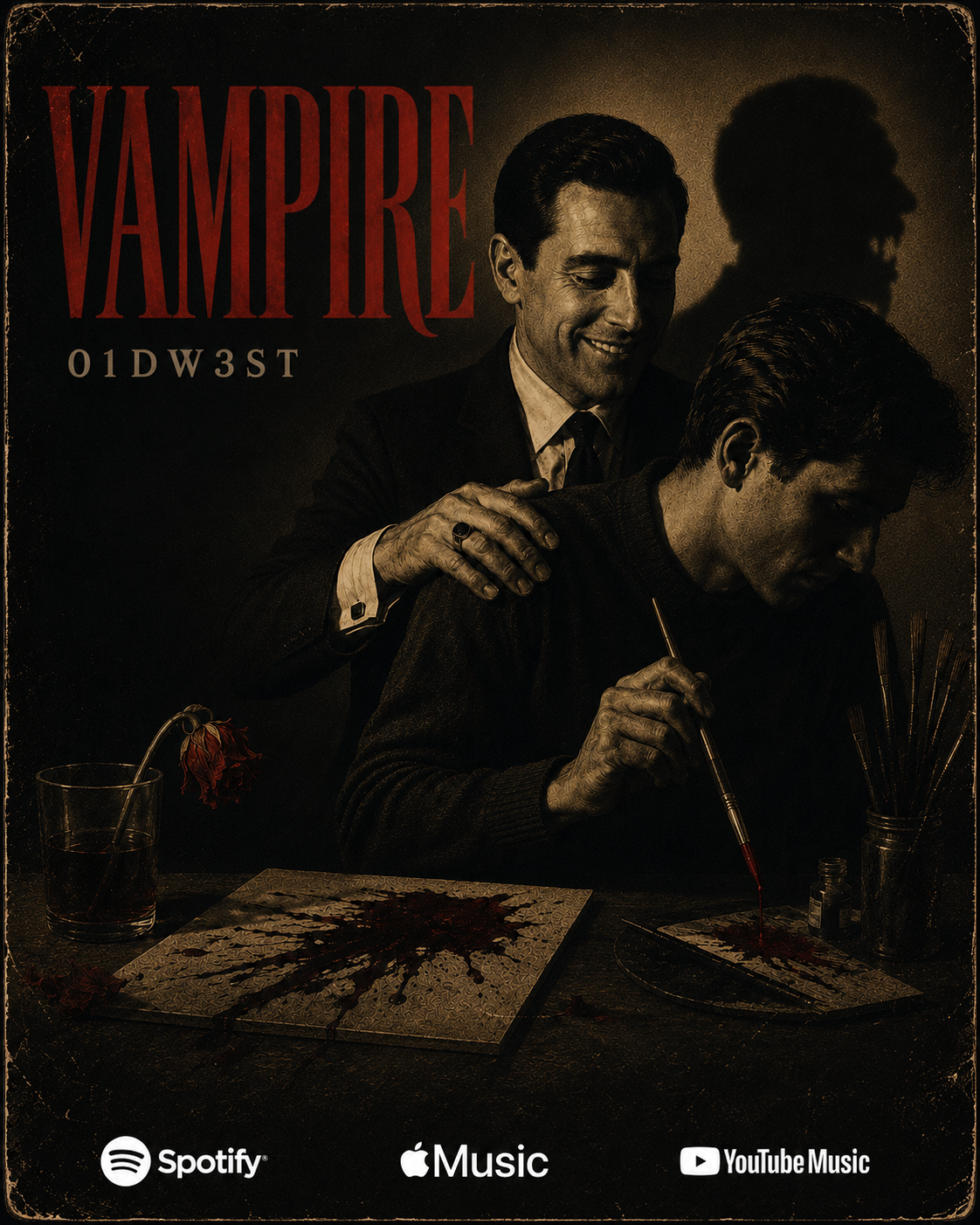
This is the companion article to "VAMPIRE," the new release by 01DW3ST. The song is about a specific kind of predator: the one who arrives smiling when an artist starts to shine, offering "relief" and calling it love. This article is the receipts — the documented history, the named people, the named substances, and the verified statistics behind every line of it.
There is a lyric at the center of the song: they don't break the brush, they break the hand. Nobody has ever destroyed a great song by burning the tape. They destroy the person who made it. And in case after documented case, the destruction did not begin with the artist alone in a dark room. It began with someone else in the room — a studio executive with a pill bottle, a doctor with a prescription pad, a "friend" with a , a dealer with a tablet — someone who profited, personally or financially, from keeping a brilliant person medicated, dependent, and .
This article does four things. It lays out the hard numbers on how substance abuse actually affects musicians and artists as a population — in plain words, so the numbers land. It names the predators — the real, documented "vampires" — behind some of music's most famous destructions. It honors the fallen by name, with the exact substances and circumstances on the record. And it dismantles the most dangerous myth in art: that genius must suffer to create. Every claim is sourced at the bottom, and every , drug, industry term, and name is defined in the glossary at the end — so no reader needs a medical degree, a law degree, or a record collection to follow the whole story.
One thing this article is not: a lecture. is not a character flaw, and every artist named here was a human being who deserved better. The villains of this story are rarely the artists. Keep that in mind all the way down.
Why This Song Exists
"VAMPIRE" was not written from headlines. It was written from witness.
01DW3ST has seen this predator up close in personal life — not in a stadium or a tabloid, but in ordinary rooms, where the pattern looks exactly the way the song describes it. Someone starts to shine — a talent, a vision, a spark — and someone else notices. The one who notices doesn't arrive as a threat. They arrive as help, or the face of a friend. They say they understand. They say they believe in you. And then the "help" appears: something to take the edge off, something to open you up, something to get you through. It won't hurt, they say. Just this once. Just to relax. Everyone does it. And when the answer is no, they don't argue — that would show the teeth. They wait. They chip away slowly, one small hidden move at a time, always with a smile: the offer repeated at a weaker moment, the joke about being too uptight, the reminder of who else "made it" this way, the glass already poured and set down within reach. The methods stay hidden because the goal is never to force the poison on you — it is to win your agreement to take it, so that when it takes hold, you will blame yourself instead of the hand that poured. Always offered warmly. Always named as friendship, love, or relief. And always, underneath, serving the giver — because a person who is dependent is a person who is manageable, and a fire that is being quietly smothered is a fire that will never outshine the one holding the blanket.
That is the hidden intention the song exists to expose: the predator who operates under the name of help. The famous cases in this article are the same story at maximum volume — the studio that "helped" a teenage girl keep her energy up, the doctor who "helped" the King sleep, the who "helped" a 14-year-old relax, the psychiatrist who "helped" protect a hard-won sobriety by installing a new dependency. The names are famous. The pattern is not. The pattern is everywhere, at every level of every creative pursuit, wherever something bright attracts something hungry.
The song's instruction is the article's instruction: learn the pattern, so you recognize the smile. If they circle when you're shining — never let them in.
Part One: The Numbers Don't Lie
The song claims the pattern repeats. Here is the proof that it does — with every number explained as it lands.
Musicians die decades early. The largest study ever done on the subject — psychologist and actuary 's analysis of 13,195 popular-musician deaths between 1950 and 2014 — found that popular musicians die up to 25 years younger than everyday people, with death rates roughly twice as high across the whole age range. Picture two groups the same size and the same ages, one made of ordinary people and one made of popular musicians: over the same stretch of years, about twice as many of the musicians die, and a musician's life can end a full quarter-century sooner. The extra deaths were not random. They came from suicide, homicide, and accidents — including drug overdoses — plus liver disease, the classic signature of alcohol, in every age group examined. Among male musicians who died under 65, the researchers counted 136 violent deaths where only 63 would have been expected — more than double — along with 69 extra deaths from liver disease that ordinary life would never have produced1.
Fame itself carries a measurable death toll. A landmark research team led by public-health professor — in a pair of studies bluntly titled "Elvis to " (2007) and "Dying to Be Famous" (2012) — tracked 1,489 North American and European rock and pop stars against ordinary people matched for age, sex, and background. Forty years after reaching fame, the stars' survival rate had fallen to just 87.6% of what it should have been2. Two findings inside that number speak directly to the song's theme. First, solo artists died at twice the rate of band members — 22.8% versus 10.2%. Put simply: for every band member the study lost young, it lost two solo artists. Being alone kills, and the vampire prefers a target with no bandmates watching the door. Second, stars who had suffered (ACEs) — abuse, neglect, a home full of chaos — were 3.2 times more likely to die from substance-related causes3. An artist who was hurt as a child was more than three times as likely to be killed by drugs or alcohol as one who wasn't. The predator does not choose victims at random; the wounded shine brightest and defend worst.
The "" is a myth — but the truth behind it is worse. A 2011 study in the (BMJ) examined 1,046 UK chart-topping musicians and found no special spike in deaths at age 27 — the death rate at age 25 and the death rate at age 32 were virtually identical4. What the study found instead is more frightening than the legend: famous musicians face two to three times the risk of death of ordinary people throughout their entire twenties and thirties. There is no cursed year. There is a cursed decade and a half — roughly ages 20 to 39 — and it lands exactly when an artist is newly famous, newly wealthy, newly surrounded by smiling strangers, and newly profitable to keep impaired6.
Drug-related celebrity deaths moved from the street corner to the medicine cabinet. A 2016 study in the journal Substance Abuse Treatment, Prevention, and Policy 220 drug-related celebrity deaths between 1970 and 2015 — musicians were the largest group5 — and documented a clear shift after the year 2000 toward deaths involving prescription drugs, especially prescription opioids, and often several drugs combined. The vampire modernized: the syringe in the alley became a signature on a prescription pad, and then a counterfeit pill pressed with .
The pipeline is full right now. Record Union's 2019 survey of nearly 1,500 independent musicians — "The 73 Percent Report" — found that 73% had experienced stress, anxiety, or depression related to their music. That is roughly seven out of every ten working independent artists7; among artists aged 18–25 it rises to 80%, or eight out of ten, and a full third reported panic attacks. Yet only 39% had ever sought professional treatment — about four in ten — while 51% reported self-medicating with alcohol and drugs — more than five in ten already "treating" themselves with the exact "relief" the predator sells. And just 19% believed the music industry was working to create healthy conditions for artists — barely two in ten. The UK charity ' large "Can Music Make You Sick?" study (2016) confirms the picture, finding musicians reporting depression and anxiety at roughly three times the rate of the general public8. Self-medication is the vampire's open door, and more than half of struggling artists are standing in it.
And the water everyone is swimming in: at the peak of the crisis, the United States lost more than 110,000 people to drug overdoses in a single year (2023) — more than 300 people every single day — the majority involving illegally made fentanyl, before figures showed a major decline toward roughly 80,000 in 202418. Several of the artists in this article — Prince, Tom Petty, , — are line items in those national statistics, killed not by the drug they thought they were taking but by fentanyl hidden inside a counterfeit pill.
That is the statistical skeleton. Now the names.
Part Two: The Vampires, By Name
The song's central figure — the smiling predator "with the face of a friend" — is not a metaphor. In case after case, the historical record identifies a specific person or that supplied, prescribed, or engineered an artist's dependency, and profited from it.
The studio system and Judy Garland
was put on amphetamines (pep pills like Benzedrine) and barbiturates (sleeping pills) as a teenager under contract at — stimulants to power brutal filming schedules and suppress her weight, sedatives to knock her out at night. She later described the studio routine as pills to wake, pills to work, pills to sleep, on repeat, from childhood. The dependency installed in her teens ran her whole life. She died on June 22, 1969, at age 47, of an accidental overdose of secobarbital (the Seconal). The vampire here was not a person but an institution: a movie studio that treated a child's body chemistry as a production schedule to be managed.
"Doctor" Toby Marshall and Hank Williams
— arguably the most influential country songwriter who ever lived — spent his final year under the care of , a forger with a purchased mail-order diploma who passed himself off as a doctor10 and prescribed Williams , a heavy sedative, on top of Williams's severe alcoholism and the shots he received for back pain. Williams died in the back seat of his Cadillac on January 1, 1953, at age 29; the fraud of his "doctor" was exposed at the inquest that followed. A literal fake healer, feeding sedatives to a drowning man — the song's "helping hand with a hidden blade" has rarely been more literal.
Dr. George Nichopoulos ("Dr. Nick") and Elvis Presley
died on August 16, 1977, at age 42; toxicology found a cocktail of prescription drugs including , (Quaaludes), and multiple barbiturates and sedatives. The investigation that followed revealed that his personal physician, Dr. George Nichopoulos, had prescribed him more than 10,000 doses of sedatives, amphetamines, and narcotics in the first eight months of 1977 alone — that is more than 40 doses per day, every day. Nichopoulos was of criminal in 1981, but the Tennessee medical board permanently revoked his license in 199511 for a pattern of overprescription that extended to other patients. He remained on Elvis's payroll to the end — the salaried friend whose relief came in amber bottles.
Dr. Conrad Murray and Michael Jackson
The starkest modern case. died on June 25, 2009, at age 50, of acute propofol intoxication combined with benzodiazepines (lorazepam and midazolam). Propofol is a hospital-grade surgical with no legitimate use as a sleep aid, yet Dr. — hired at $150,000 per month to accompany Jackson's comeback tour — had been infusing it into Jackson nearly nightly for about two months in a private bedroom, without proper monitoring equipment. A jury Murray of in November 201112; he was sentenced to four years and served about two. He called what he administered "milk" — they call it love, they call it relief.
The husband, the handlers, and the government: Billie Holiday
— one of the most influential vocalists in American history — was introduced to in the 1940s within her circle of husbands and hangers-on, and spent her money and health on men who both. But her most relentless predator wore a badge: , of the (FBN), pursued her personally for years as a public example, sending agents after her rather than help9. She was arrested and handcuffed on her deathbed in a New York hospital in 1959, her flowers and records , police posted at the door as she died of and heart failure on July 17, 1959, at age 44. When the vampire runs the system, there is nowhere to report the bite.
"Ready Ron" and DMX: the blunt that was laced
Earl Simmons — — told the story himself, on camera, in a 2020 interview: at 14 years old, his music mentor, an older local rapper he trusted and looked up to16, passed him a blunt that was secretly laced with . "A monster was born," DMX said. He spent the rest of his life fighting the addiction that was installed in him, as a child, by a friend's hand. He died on April 9, 2021, at age 50, after a -induced heart attack that led to . Of every story in this article, this is the one the song's chorus describes with zero poetic license: the face of a friend, the hidden jab, the spark taken from a hand — a 14-year-old's hand.
The counterfeit-pill supply chain: Mac Miller, Lil Peep, Prince
The modern vampire often never meets the victim. Mac Miller died on September 7, 2018, at age 26, from a combination of fentanyl, cocaine, and alcohol after taking counterfeit pills that were actually pressed with fentanyl. Federal prosecutors traced the supply chain: the dealer who supplied the pills, Stephen Walter13, was sentenced to 17 and a half years in federal prison; a middleman received roughly 11 years. Lil Peep (Gustav Åhr) died on November 15, 2017, at age 21, of fentanyl and — counterfeit Xanax, again laced. Prince died on April 21, 2016, at age 57, of an accidental fentanyl overdose from counterfeit Vicodin he believed was legitimate pain medication for hips worn out by decades of performing; investigators never determined who supplied the pills, and no one was criminally charged in his death14. Three of the most gifted artists of their generations, killed by product mislabeled by people who never had to watch them die.
The prescription pad, again: Stevie Nicks's stolen decade
A survivor's version of the same story. Stevie Nicks of beat a ferocious cocaine addiction — one that burned a hole in her septum large enough that a plastic surgeon warned her another line could be her last — by checking into the in 1986. Then, she has said in interview after interview, a psychiatrist prescribed her the (clonazepam) "to protect her sobriety" and kept her on rising doses for roughly eight years. She describes 1987–1994 as stolen years — creativity flattened, weight and health wrecked — and the 47-day that followed as harder than kicking cocaine. She got out. Many don't. The lesson she draws is the song's bridge verbatim: the poison came dressed as freedom, from a professional whose job title said healer.
Look at the pattern across a century: a studio, a quack, two salaried physicians, a federal commissioner, a trusted mentor, an anonymous pill press, a psychiatrist. Different faces. Same smile. Same transaction: the artist's dependency was, for someone else, a salary, a conviction rate, a market, or a management tool.
Part Three: The Fallen — Names, Substances, Ages
Think of the names, think of the stars. Here they are, era by era. Each entry is the public record: coroner findings, toxicology, and documented history. This list is not complete — no list could be — but it is exact.
The first generation (1950s–1960s)
— the most influential saxophonist in jazz history — became dependent on morphine at 16 after a car accident, graduated to heroin, and battled it alongside heavy alcohol use for the rest of his life. He died on March 12, 1955, at age 34, of and ulcer complications compounded by cirrhosis; the coroner, examining his ravaged body, estimated his age at more than 50. A generation of young jazz players, believing heroin was the source of his genius rather than his destroyer, followed him into addiction — the suffering-genius myth working exactly as the vampire needs it to.
Billie Holiday (heroin, alcohol; died 1959, age 44, cirrhosis — profiled above). Hank Williams (alcohol, morphine, chloral hydrate; died 1953, age 29 — profiled above). Judy Garland (studio-installed amphetamines and barbiturates; died 1969, age 47 — profiled above).
The rock era and the so-called 27 Club (1969–1971)
, founder of the Rolling Stones, drowned in his swimming pool on July 3, 1969, at age 27; the coroner recorded misadventure, noting a liver and heart already enlarged by years of drug and alcohol abuse — the band had fired him weeks earlier as the addiction consumed him.
died in London on September 18, 1970, at age 27, asphyxiating after taking many times the normal amount of Vesparax, a powerful prescription barbiturate sleeping pill, with wine.
died sixteen days later, on October 4, 1970, at age 27, of a heroin overdose compounded by alcohol — the batch she bought was far purer than street normal, and it killed several of the same dealer's other customers that week. The dealer walked away. The vampire usually does.
of The Doors was found dead in a Paris bathtub on July 3, 1971, at age 27. French authorities recorded heart failure and performed no ; the weight of testimony from those around him points to heroin, likely snorted by a heavy drinker who didn't know its strength.
Four global stars, 27 years old, in 24 months. The myth of a cursed number was born here — but as Part One showed, the number was never the curse. The exposure was.
The toll of the 1970s–1980s
Elvis Presley ( — codeine, Quaaludes, barbiturates; died 1977, age 42 — profiled above).
, The Who's drummer, died on September 7, 1978, at age 32 — from an overdose of (Heminevrin), the very sedative prescribed to help him through alcohol withdrawal. The medicine meant to save him from one substance killed him as another.
Sid Vicious of the Sex Pistols died of a heroin overdose on February 2, 1979, at age 21 — by most accounts from a supply his own mother helped procure, hours after his release from the Rikers Island jail.
, 's , died on February 19, 1980, at age 33, of acute alcohol poisoning after a night of heavy drinking, left to sleep it off in a parked car; the coroner ruled death by misadventure.
, 's drummer, died on September 25, 1980, at age 32, asphyxiating in his sleep after consuming the equivalent of roughly forty measures of vodka in a day. Led Zeppelin rather than replace him.
— not a musician but included deliberately, because the song says brush: the most celebrated painter of his generation died of a heroin overdose on August 12, 1988, at age 27, isolated in his studio at the peak of an art market that treated him as a product line. They didn't break his brushes. They broke the hand.
The 1990s: grunge's graveyard
of died by suicide on April 5, 1994, at age 27, with heroin and in his system after years of chronic heroin addiction he framed partly as self-medication for undiagnosed stomach agony. Weeks earlier he had survived an overdose-induced in Rome; the machinery of the tour rolled on.
of Sublime died of a heroin overdose on May 25, 1996, at age 28 — one week after his wedding, two months before the album that would make his band massive. He never saw a moment of the success.
Shannon Hoon of died of a cocaine overdose on his tour bus on October 21, 1995, at age 28, months after the birth of his daughter.
of — owner of one of rock's most haunting voices — died on April 5, 2002, at age 34, of a heroin and cocaine combination (a speedball), alone in his Seattle condo. His body, weighing 86 pounds, was not found for two weeks. His band had effectively stopped touring years earlier because he could no longer function; the isolation the statistics warn about closed over him completely.
The 2000s–2010s: the prescription era
Whitney Houston, the most awarded female artist of her era, drowned in a hotel bathtub on February 11, 2012, at age 48; the coroner listed accidental drowning with heart disease and cocaine use as contributing factors, after decades of publicly documented struggle.
died on July 23, 2011, at age 27 — of alcohol poisoning, with a blood-alcohol level of 416 mg per 100 mL15, more than five times the UK drink-drive limit, her body weakened by years of and an earlier period of crack cocaine and heroin use that her ex-husband, by his own public admission, introduced her to. The world watched her collapse in real time and bought tickets to it; her final concert weeks earlier, in Belgrade, was a stadium full of people booing a visibly woman. No more calling it a party when another artist dies.
Michael Jackson (propofol and benzodiazepines; died 2009, age 50 — profiled above). Prince (counterfeit-pill fentanyl; died 2016, age 57 — profiled above).
Tom Petty died on October 2, 2017, at age 66, of an accidental overdose of multiple medications including fentanyl, oxycodone, and sedatives. His family disclosed the reason he was taking them: he had toured his final 53-show run on a hip because he did not want to let down his crew and fans, medicating the pain to stay on stage until the hip fully broke. The industry got its tour. Petty paid for it.
The fentanyl generation
Lil Peep (fentanyl and alprazolam via counterfeit Xanax; died 2017, age 21 — profiled above). Mac Miller (fentanyl via counterfeit oxycodone; died 2018, age 26 — profiled above).
(Jarad Higgins) died on December 8, 2019, at age 21, of oxycodone and codeine toxicity, suffering a seizure at Chicago's Midway Airport — reportedly after swallowing pills as federal agents searched his private jet. He had rapped openly, over and over, about drugs as self-medication for anxiety, and about not expecting to see his twenties out. An entire industry those lyrics in real time.
DMX (cocaine-induced heart attack; died 2021, age 50 — profiled above, along with the man who laced his first blunt at 14).
Part Four: The Survivors — and What It Cost Them
The song ends with a stake, not a funeral. So does the record. These artists faced the same vampires and lived — and every one of them describes recovery, not the drugs, as the thing that saved their art.
survived a full-blown heroin addiction in the early 1970s, only to replace it with alcoholism so severe he has said he drank around the clock for years. Sober since the late 1980s, he founded the treatment facility in Antigua in 1998 and funds it partly with guitar auctions — a survivor building the safehouse he never had.
spent the 1980s in cocaine and alcohol addiction compounded by bulimia; he has been sober since 1990 and has said plainly that he would be dead without recovery. More than three decades on, he still attends support meetings and has become one of music's most vocal advocates for getting help early.
of the Rolling Stones — the era's most drug user — kicked heroin in the late 1970s after a Toronto trafficking arrest nearly ended the band. The myth says he thrived on it; his own accounts describe missed years, dead friends, and luck he does not recommend anyone bet on.
spent the mid-1970s in a cocaine psychosis so deep he later said he could remember almost nothing of recording one of his most acclaimed albums. He fled Los Angeles to get clean and lived another four decades of restless creation — proof, in his own telling, that the work came from him and not the powder.
Stevie Nicks (cocaine, then eight prescribed years of Klonopin — profiled above) survived both the party and the prescription pad, and has spent decades warning younger artists about the second one specifically.
of was declared clinically dead for roughly two minutes after a heroin overdose on December 23, 1987, revived by adrenaline shots — an event he turned into the song "Kickstart My Heart" and the book The Heroin Diaries, one of the most unglamorous accounts of addiction ever published by a rock star17. Sober for decades, he is blunt that the diaries describe a man who was not creating — he was dying with a bass in the room.
Steven Tyler of has been through multiple recoveries — the band famously got sober together in the late 1980s, producing their biggest commercial run after the drugs — including a relapse triggered by prescription opioids after foot surgery in 2008, followed by treatment and continued sobriety. His story makes a point the vampire hates: relapse is not failure; it is a signal to get help again.
Eminem nearly died in December 2007 from a overdose — he has said doctors told him he had taken the equivalent of four bags of heroin and that his organs were shutting down. Sober since April 20, 2008, he retitled two albums around the journey — Relapse and Recovery — and has described having to relearn how to rap without the pills, then releasing some of the biggest work of his career. He celebrates his sobriety anniversary publicly every year, medallion posted, precisely because he knows who is watching.
survived a 2018 overdose from fentanyl-laced drugs that caused three strokes and a heart attack, leaving lasting vision damage — and has been public about every step since, converting survival into advocacy.
Different genres, different decades, one shared testimony: not one of them credits the substances with their art, and every one of them describes the people who kept supplying them — and the culture that cheered — as part of what nearly killed them.
Part Five: The Myth That Genius Must Suffer
The world keeps buying the myth they sell — that genius must suffer to sing that well. The myth is the vampire's marketing department, and it deserves to be dismantled on the evidence:
The data points to wounds, not gifts. The Bellis studies found that substance-related deaths among stars were driven overwhelmingly by childhood experiences — trauma that predates the first hit record. The drugs never came from the talent. They came from the pain, and from the people who monetized it. Talent and addiction travel together not because one causes the other, but because wounded people make art and make targets.
The artists themselves testify against the myth. Bowie couldn't remember making the album. Sixx's diaries record paranoia and paralysis, not inspiration. Eminem says the pills eventually took the rhymes. Clapton describes drinking away entire creative years. Aerosmith's biggest albums came after sobriety; Eminem's Recovery became one of the best-selling albums of its decade — made clean. 's towering late-career American Recordings albums were made in recovery. The catalog of great sober work is enormous; the catalog of final albums cut short is the graveyard above.
The myth kills the audience too. Charlie Parker's imitators took up heroin believing it was the source of the sound. Generations of young artists have chased the chemical "secret" of heroes who were, in reality, being consumed. Every time the culture romanticizes an artist's destruction — every "live fast, die young" T-shirt, every candlelit 27 Club — it does free advertising for the vampire.
The truth the record supports: creativity survives sobriety just fine. What it rarely survives is the dealer on retainer, the doctor on payroll, and the crowd that keeps calling it a party.